
In April 1778, toward the end of a brutal winter, General George Washington’s Continental Army troops were sick and starving at Valley Forge, some 30 miles north of Philadelphia in what is now Pennsylvania. Washington sent an appeal to the Oneida Indian Nation in what is now New York for knowledgeable scouts and warriors. In response, more than 40 men and one woman, Polly Cooper, traveled more than 200 miles carrying corn to the desperate soldiers. While the Oneida men became scouts and served alongside Washington’s men in battle, Cooper taught the soldiers how to cook the white corn into a digestible food, most likely soup, mush and bread.
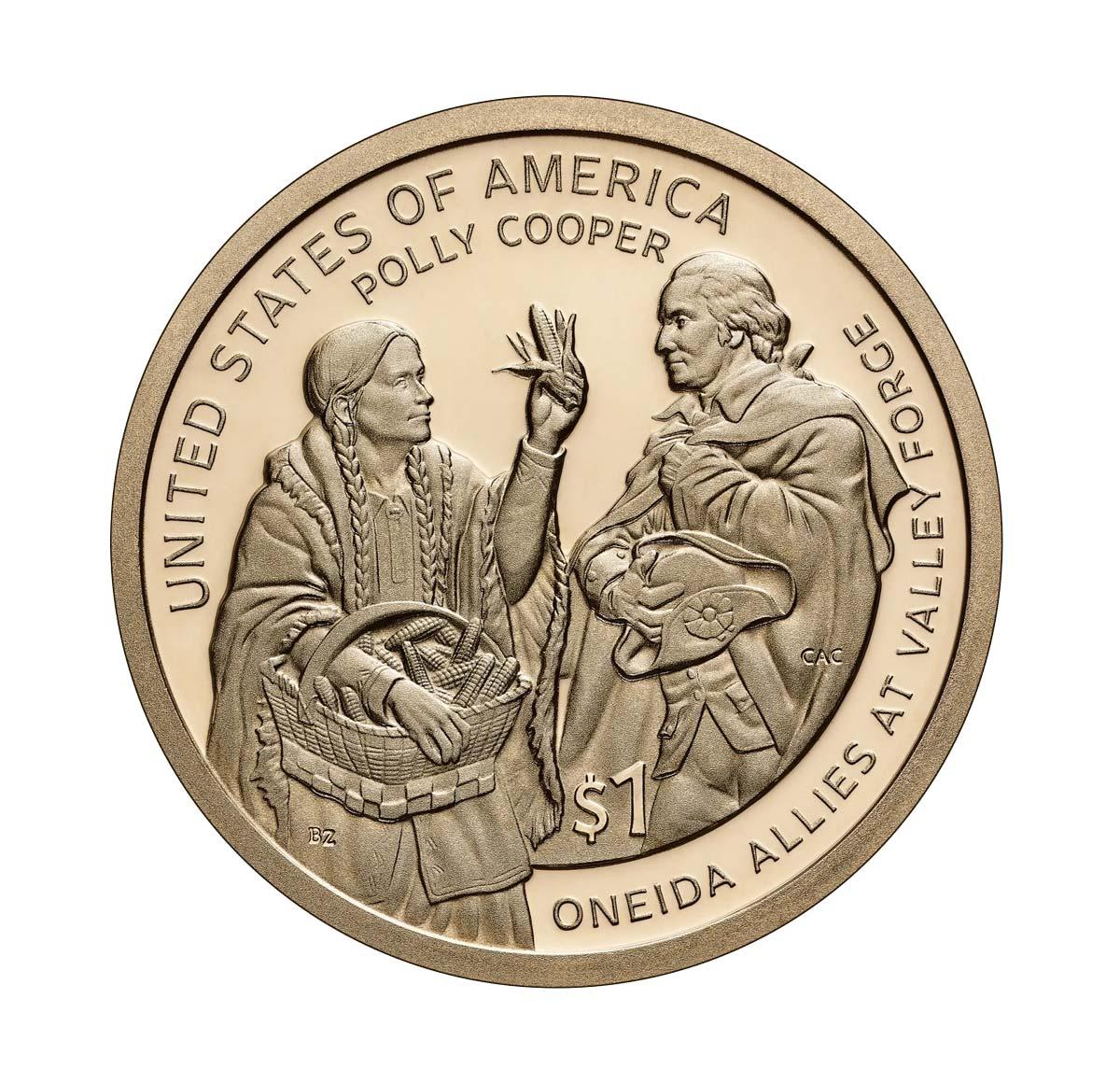
In January 2026, the U.S. Mint released this $1 coin featuring Polly Cooper (left) in recognition of her and her Oneida people’s support of the Continental Army troops led by George Washington (right) during the American Revolution.
Photo courtesy of U.S. Mint.
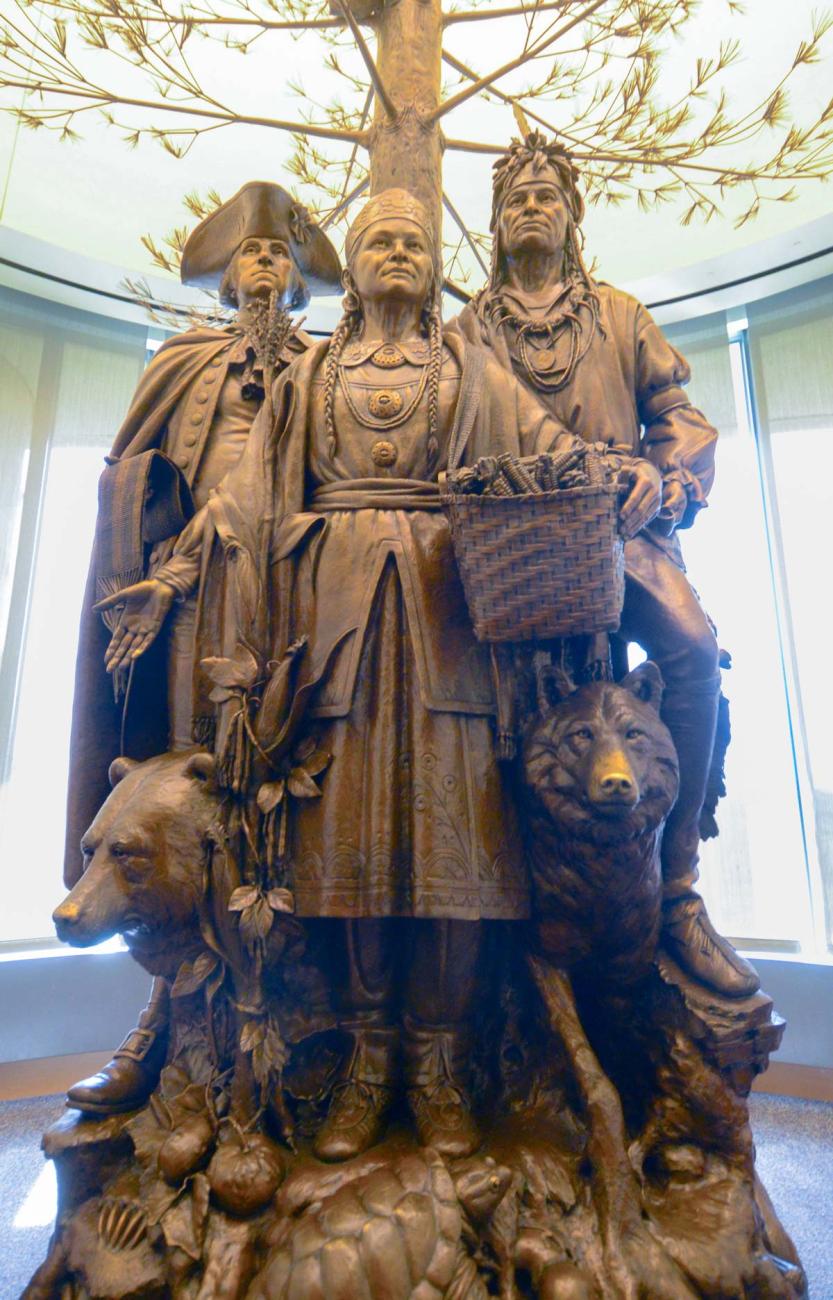
The Oneida Nation gave the statue “Allies in War, Partners in Peace” to the National Museum of the American in Washington, D.C. The statue features Polly Cooper (center) with General George Washington (left) and Oneida Chief Shenendoah (right) under the Tree of Peace.
Photo by Patrick G. Ryan

Left to right: Whitney Roach ᏩᏚᎵᏏ (Wa-Du-Li-Si, Cherokee Nation), Becky Lynette White (Shawnee) and Teyotsihstokwáthe Dakota Brant (Mohawk Nation) all have ties to Indigenous women leaders during the American Revolution.
In recognition of the Oneida Indian Nation’s aid as some of America’s first allies, the United States Mint released a $1 coin featuring Cooper on its face in January. The 2026 coin is the latest in the Mint’s ongoing Native American $1 Coin series, for which NMAI has provided input about who to feature on the coins. This year’s design was inspired in part by “Allies in War, Partners in Peace,” a 20-foot bronze statue the Oneida Indian Nation presented to the National Museum of the American Indian when it opened in Washington, D.C., in 2004. The statue depicts Cooper alongside Washington and Oneida Chief Shenendoah (also known as Skenandoah or Oskanondonha), who helped align the Oneida with the colonists and fought with them at Oriskany and Saratoga in what is now New York and Barren Hill near Philadelphia.
While Cooper’s story is one of the more well-known of Native women who lived during the American Revolution era, many others played important roles. They were central to strategy, diplomacy and even survival of their people during this pivotal time in history.
Highlighting their legacies was part of the motivation of NMAI’s educational program Native Knowledge 360º (NK 360º) to produce a series of free teacher and student resources about the American Revolution for middle school students. The first of the three online lesson packages highlights Native women leaders during this historic time and some of their descendants. The three contemporary Native women in the lesson are pictured on a downloadable poster that has been distributed to more than 3,000 classrooms.
“I think, especially for students, that historical empathy is essential in really knowing and connecting to [historic figures],” said Caitlin Lochridge, an education program specialist who helped produce the lessons. “It can help shape a broader perspective and understanding of different governments, lifeways and cultures. … These were real people with lived experiences.”
The history of the American Revolutionary War era has often been recorded by men who wrote mostly about other men. But many Native nations were and still are matrilineal, or led by women, whose contributions live on in family and community members’ memories.
“The true histories are in the stories of the people and the family stories,” said Katsi Cook (Saint Regis Mohawk Tribe), who leads Spirit Aligned Leadership, a nonprofit she founded to connect younger women with matriarchs. The Mohawk are among the six tribes of the Haudenosaunee Confederacy in New York and Canada. She is a co-author of the forthcoming book “American Indigenous Democracy,” which explores how the United States drew on the Haudenosaunee’s thousand-year-old democratic practices to form its own. She said, “We have legacies inside of us that require expression — that come from them.”
Early colonial records show British negotiators dealing directly with women from the many matrilineal nations. However, that shifted after the United States was established, as American representatives showed a preference for negotiating with men. How each tribal community responded or was influenced by that choice varied, just as the war effort had not affected all tribal nations equally. Native people also sometimes chose individually whether to support the American patriots or the British loyalists.
In what is now upstate New York, Konwatsi’tsiaienni (also known as Molly or Mary Brant) became a key political figure for both the Haudenosaunee Confederacy and the British. A Mohawk woman, she had traveled with tribal leaders to negotiate land rights with the British before marrying Sir William Johnson, a British superintendent for Indian Affairs, and taking over management of Johnson Hall, her husband’s estate where she hosted dignitaries at his side.
“William Johnson understood the value that Mohawk people put into the voice of their women,” said Teyotsihstokwáthe Dakota Brant of the Ohswé:ken Territory in the Mohawk Nation. She is Konwatsi’tsiaienni’s fourth great-niece. “He understood to have strong alliances with Indian partners, he needed to have strong alliances with Mohawk,” she said. And that “a lot of the decisions were filtered through their women.”
Konwatsi’tsiaienni kept running Johnson Hall even after her husband’s death in 1774. During the Revolutionary War, the British asked her to help bring the Haudenosaunee over to their side. She and her younger brother, Thayendanegea (Joseph Brant), eventually did as they thought an alliance with the British offered their people’s best chance to hold onto their homelands.
“Molly Brant, I think, was somebody who was very sure of herself, and she knew what she wanted for herself and her family,” Teyotsihstokwáthe said. She is directly descended from Joseph Brant, Konwatsi’tsiaienni’s brother, and grew up hearing stories about both of them. Her mother took her and her three sisters to Mohawk Valley in New York each summer, where they often visited Johnson Hall — a tradition she continues with her own children. “It’s not just a family history, it’s the history of the Six Nations,” Teyotsihstokwáthe said.
In 1777, Konwatsi’tsiaienni warned the British of an impending American attack, helping set up the ambush at the Battle of Oriskany. The British later granted her and her brother land in Canadian territory, part of the founding of the Six Nations of the Grand River. The Mohawk people did not want to leave their homelands, Teyotsihstokwáthe said, but they were burned out of their villages and moved to Canada, essentially as refugees.
Leadership in the Six Nations still runs through clan mothers, and the culture and way of life remain very female-centered, Teyotsihstokwáthe said. Learning about Molly Brant’s influence shows the continuity of that tradition over the centuries: “Having this kind of validation of our way of life, of someone like Molly Brant, is validating who we are as a people and the fact that this has always been who we are,” Teyotsihstokwáthe says. “We’re still the people that we were 250 years ago.”
Knowing more about the lives of these women also illuminates the wider context in which the American Revolution began. For Nanye’hi, or Nancy Ward, who was Cherokee, this was just the latest in a series of conflicts involving her people, after the Cherokee-Creek, French and Indian, and Anglo-Cherokee wars. In 1755, her husband was killed in battle, and she picked up his rifle and, according to oral history, led the Cherokee to a decisive victory over the Muscogee Creek that secured Cherokee settlements in northern Georgia, said Krystan Moser, senior cultural resource manager of the Cherokee Nation. For that, Nanye’hi was named as a War Woman or Beloved Woman, a position of very high honor in Cherokee society that entitled her to speak in the general council, lead the Women’s Council, and decide the fate of prisoners of war.
Her uncle, Dragging Canoe, staunchly opposed American settlements and planned an attack on a group of settlers. But Nanye’hi warned them, thwarting that attack.
“I think what she seemed to want more than anything was for there to be peace,” Moser said. “Her entire life has been lived against the backdrop of multiple conflicts, so I think in her mind, peace is what the end goal should be.”
She used her revered role to advocate for peace for years after the war ended in 1783 as Cherokee peoples signed treaties with the newly formed United States. As a member of the Women’s Council, she led pleas to the Cherokee Council for them not to surrender more land to the Americans. “Sometimes peace means the freedom to continue living your lives as you had been,” Moser said.
Americans’ disparaging view of the Cherokee Nation as running a “petticoat government” would figure in a transition from matrilineal governance to a governance by a council of men and through written laws. Likewise, pressure from incoming American settlers would consolidate and centralize Cherokee leadership from a network of tribal towns connected through a clan system, chief councils and a shared language and cultural norms as their land base shrank, Moser said. Men took over farming, replacing women in yet another central role. But in the last 50 years, Cherokee peoples have revitalized traditions, and that includes electing their first female chief.
“You’ve really seen a shift as people reacquaint themselves with traditions, and I think that really shows in how we are highlighting some of the women’s history stories, that maybe got overlooked for many decades,” Moser said. “Those women had those roles in history, whether we teach about it or not.”
Whitney Roach, ᏩᏚᎵᏏ (Wa-Du-Li-Si), Cherokee Nation, sixth great-granddaughter of Nanye’hi (Nancy Ward), says in one of the Native Knowledge 360º videos, “Knowing that her blood runs through my veins is very important. … When I need strength and when I need confidence, I do think back to my grandmother.”
In the story of Nonhelema, or Catherine, a powerful leader and warrior from a family of Shawnee chiefs who became an advocate for peace, Becky Lynette White (Shawnee, Roundfoot Clan Descendant of four of the five divisions of Shawnee from leaders Blackfish, Blackhoof, Black Bob, and Chief Cornstalk) sees qualities that endure in many Shawnee women. She said they are often the peacemakers.
In 1774, the Shawnee and colonists began a 20-year conflict over lands in Ohio, Kentucky and Virginia, but Nonhelema wanted peace and so, with Chief Hokolesqua, her brother, negotiated a treaty with American colonists that did cede lands but prioritized peace and safety. She worked to uphold that treaty by delivering messages between the Americans and the Shawnee and even provided cattle to feed American soldiers.
White is not known to directly descend from Nonhelema, but Eastern Shawnee Chief Glenna Wallace suggested White for the NK360° project as she is quite active in her tribal community. White said she believes she solves problems from her kitchen, where she cooks for ceremonies. When her people gather to eat, talk and laugh, she said she thinks their ancestors hear them and know that all is well.
“I have always been taught the strength of Shawnee women, and we should always be there as a help and never a hindrance,” White says. “My girls, growing up, would say ‘Well I can’t do that,’ and I would say, ‘I don’t ever want to hear that word.’ You are a Shawnee woman, I don’t ever want to hear, ‘I can’t.’”
Download the free “Native Women Leading the Way: From the Revolution to the Future” poster.