
No matter what side the Indigenous people of North America chose in the American Revolution — allying with the American patriots or the British loyalists — they did so with the intention of protecting their people and their lands. What happened before, during and after this war for independence of not only this new nation but all the Indigenous nations involved were examples of their ability to endure against overwhelming odds.
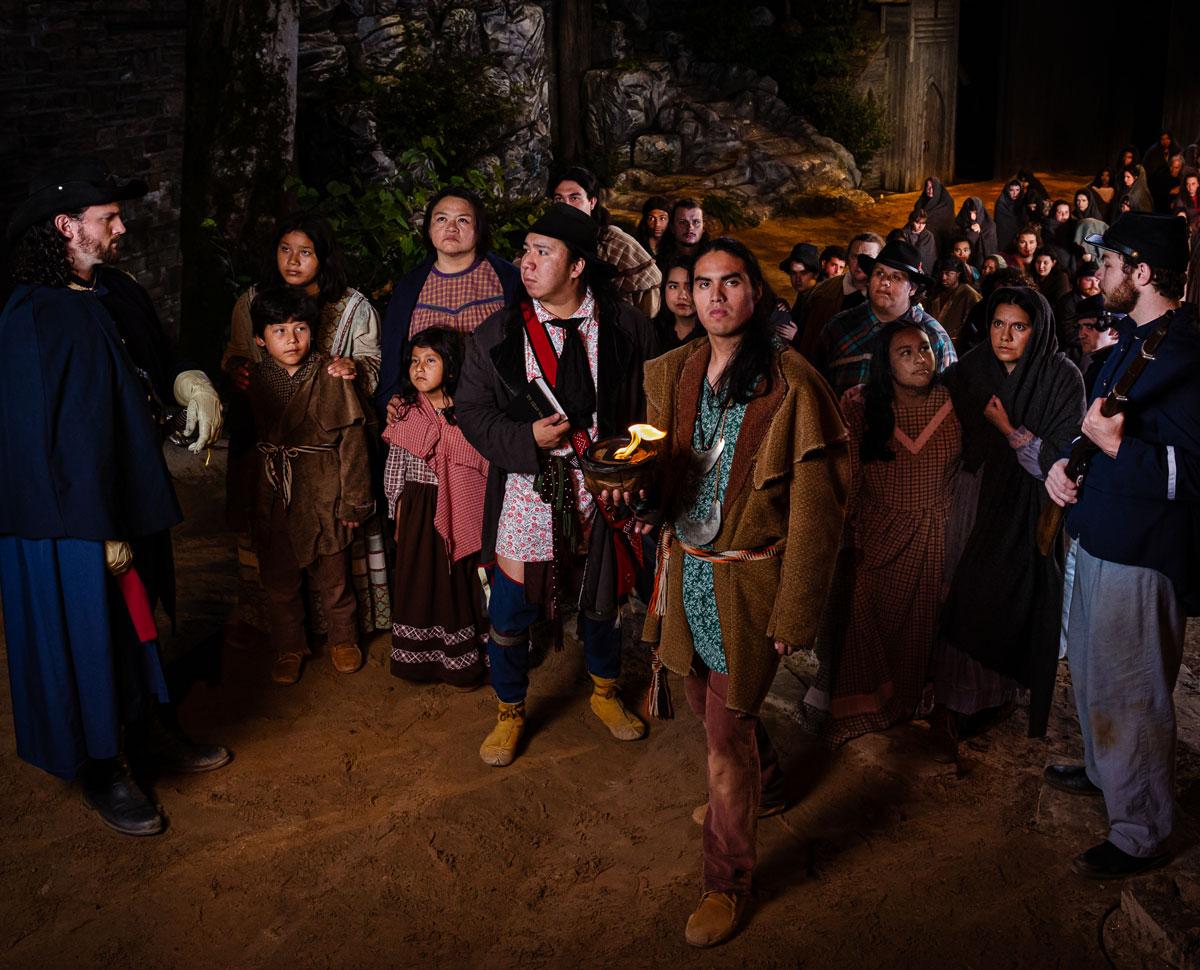
In this scene from the play “Unto These Hills,” Cherokee peoples are forced to leave their lands in the East and walk hundreds of miles on what became known as the Trail of Tears to Indian Territory in Oklahoma.
Photo courtesy of Cherokee Historical Association
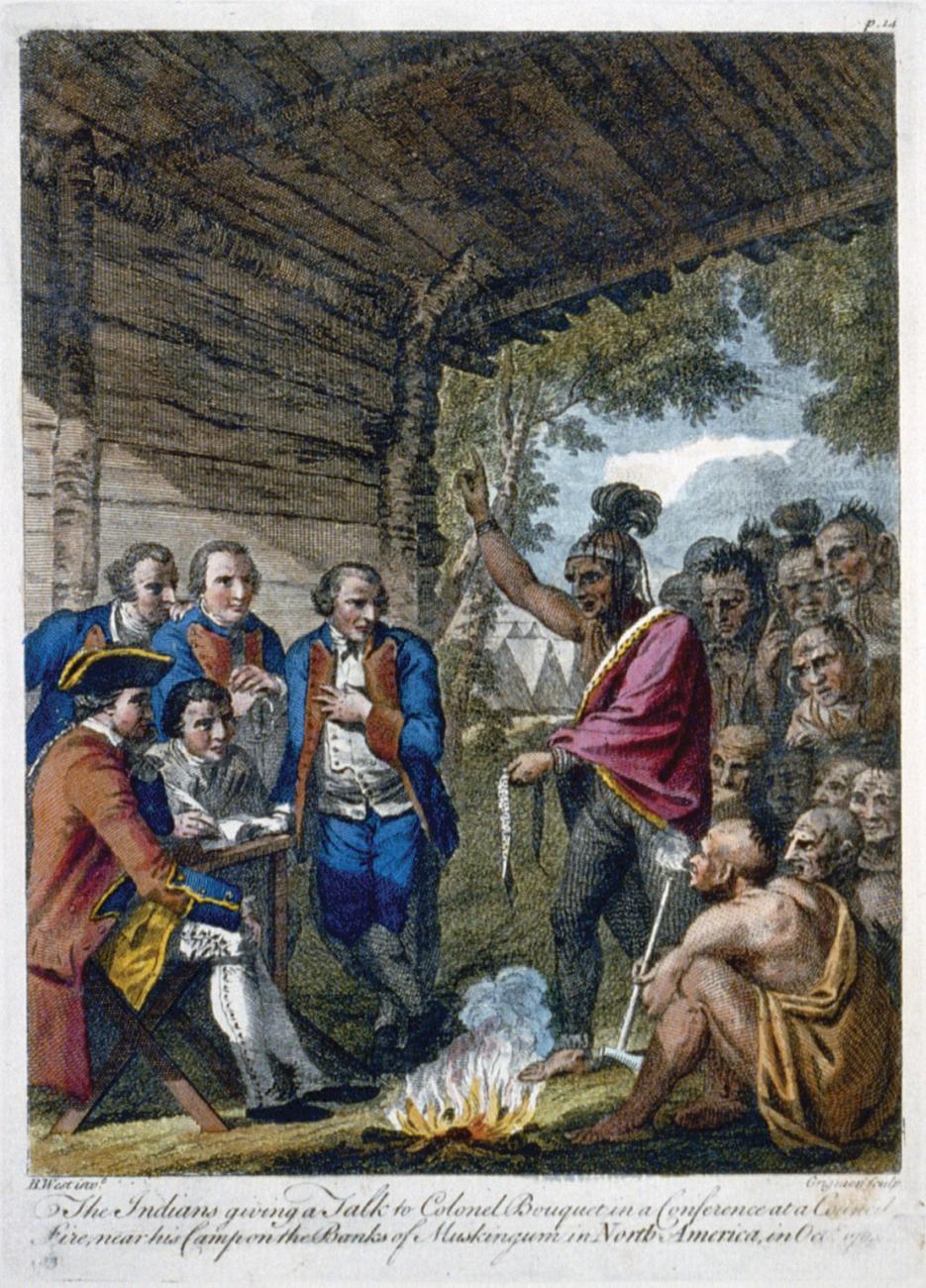
At a treaty council banquet following Pontiac’s War with the British, Kiyashuta (Seneca) said, “While you hold [a wampum belt] fast at one end, and we at the other, we shall always be able to discover anything that may disturb our friendship.”
Charles Grignion, 1766, color engraving.
Photo by Library of Congress, LC-USZC2-1596

The “Guswenta,” or “Two-Row Wampum Belt,” recorded a peace agreement between the Dutch and the Haudenosaunee Confederacy.
This replica is on display in the “Nation to Nation” exhibition at the National Museum of the American Indian in Washington, D.C.
Photo by NMAI Staff
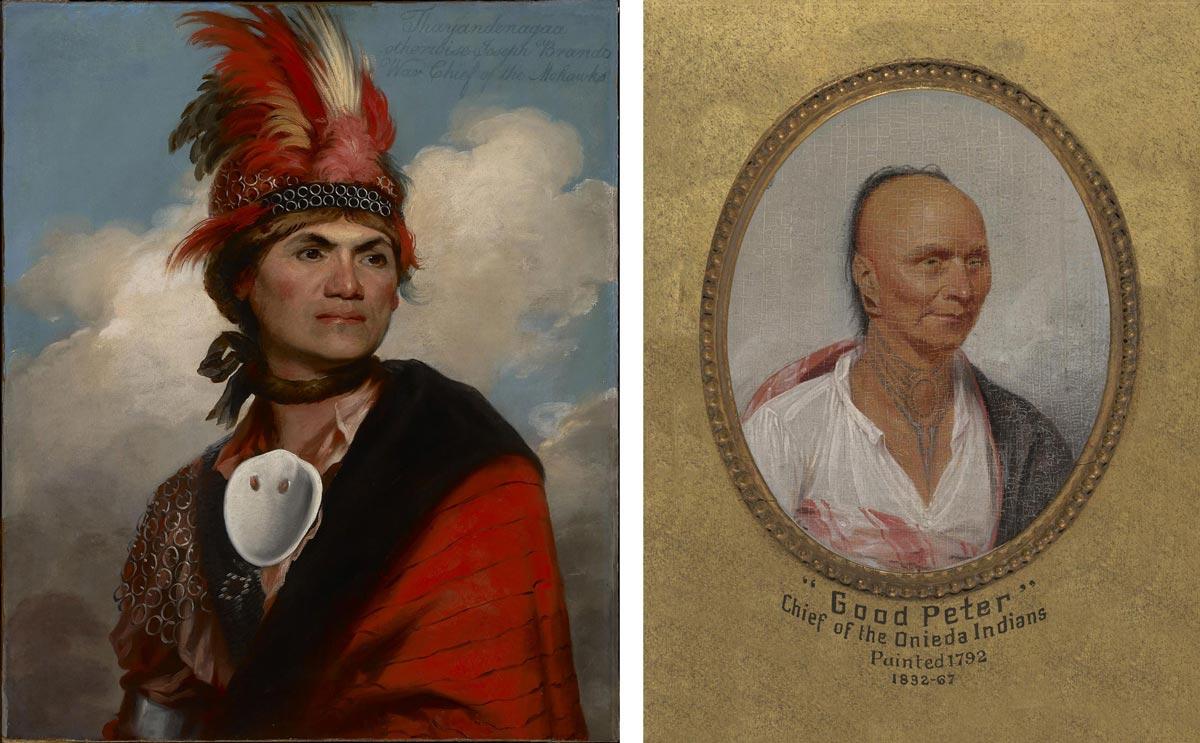
During the American Revolutionary War, members of the six tribes of the Haudenosaunee Confederacy were divided on which side to take. Mohawk warrior Thayendanegea (left, also known as Joseph Brant) felt that the British would better protect the interests of his people whereas Oneida Chief Lakwilotákwas (Good Peter) advocated to join the Americans.
Left: “Thayendanegea, otherwise Joseph Brant War Chief of the Mohawks,” Gilbert Stuart (1755–1828), circa 1785; oil on canvas; 33.5" x 28.5".
© The Trustees of the British Museum Right: “Good Peter, Chief of the Oneida Indians,” John Trumbull, circa 1717–1793; oil on wood; 4" x 3".
Photo by Trumbull Collection, Yale University Art Gallery, New Haven, CT 1832.6 7

This statue of Little Turtle (Michikinikwa) of the Miami Confederacy, known for his tactical military skills, stands on the grounds of the NMAI’s Cultural Resources Center in Suitland, Maryland.
Little Turtle (Michikinikwa), Douglas Hyde (Nimi’ipuu [Nez Perce]) and the Loveland Sculpture Works, 1998, bronze.
Photo Courtesy of Cherokee Historical Association

This peace medal marks the 1795 treaty that ended the Northwest Indian War with the agreement between several native nations and the United States. The eagle engraved on its face holds a ribbon in its beak that says “E Pluribus Unum.” Below is written “Treaty of Greenville, 3rd August 1795.”
Silver peace medal, 1795. 26/4652.
Photo by NMAI Staff
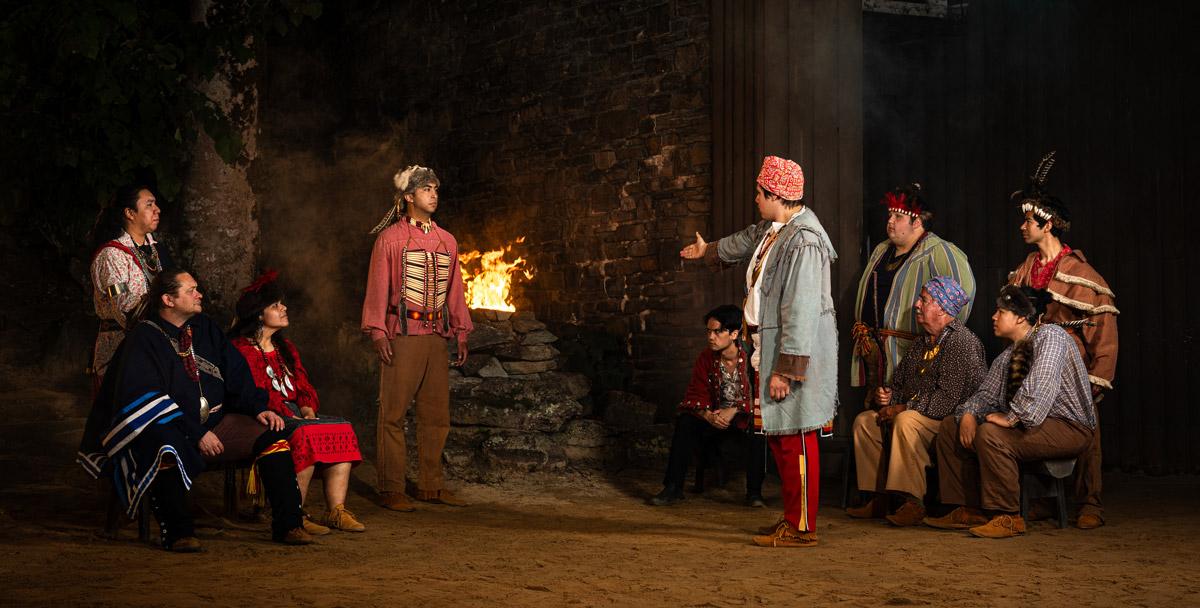
In this scene from “Unto These Hills,” Tecumseh tries to persuade Cherokee leaders to fight the settlers encroaching on their lands, however, they decide to strive for peace.
Photo Courtesy of Cherokee Historical Association
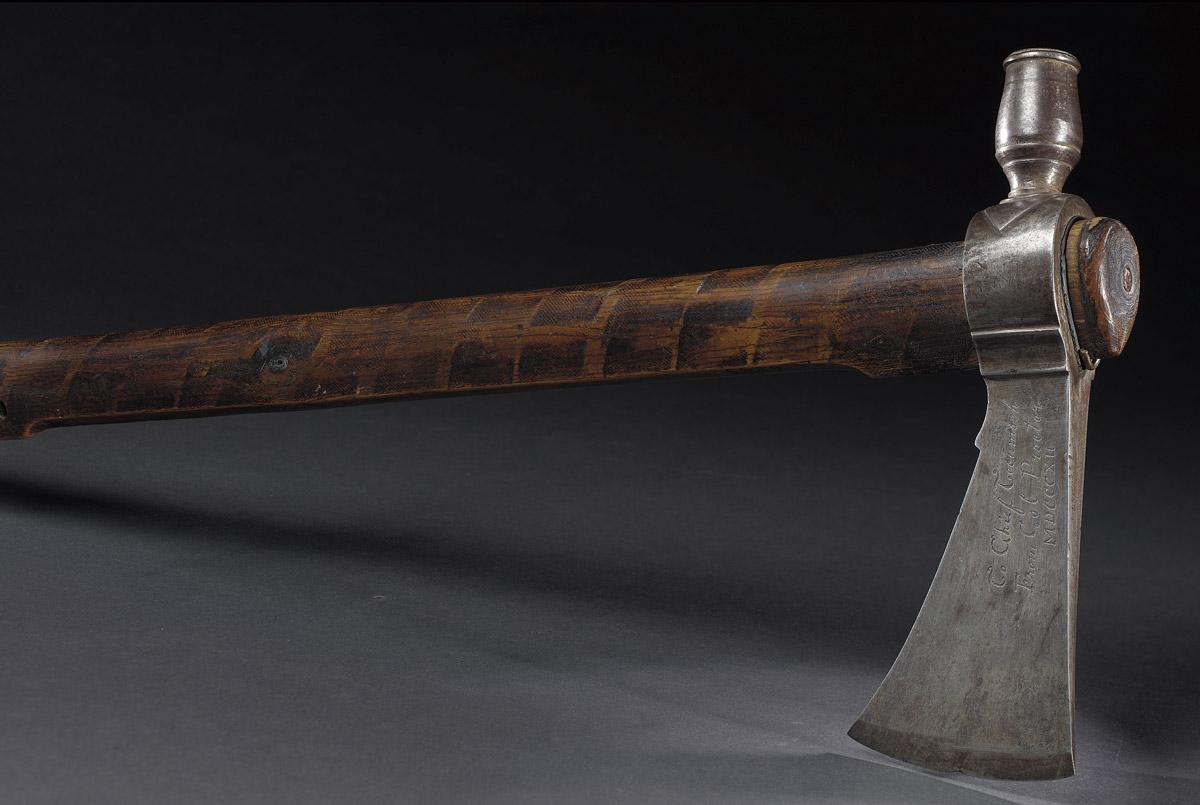
Pipe tomahawk in the NMAI collection that was presented to Shawnee Chief Tecumseh.
Peace pipe, circa 1812; wood, iron and lead; 26" x 9". 17/6249
Photo by NMAI Staff
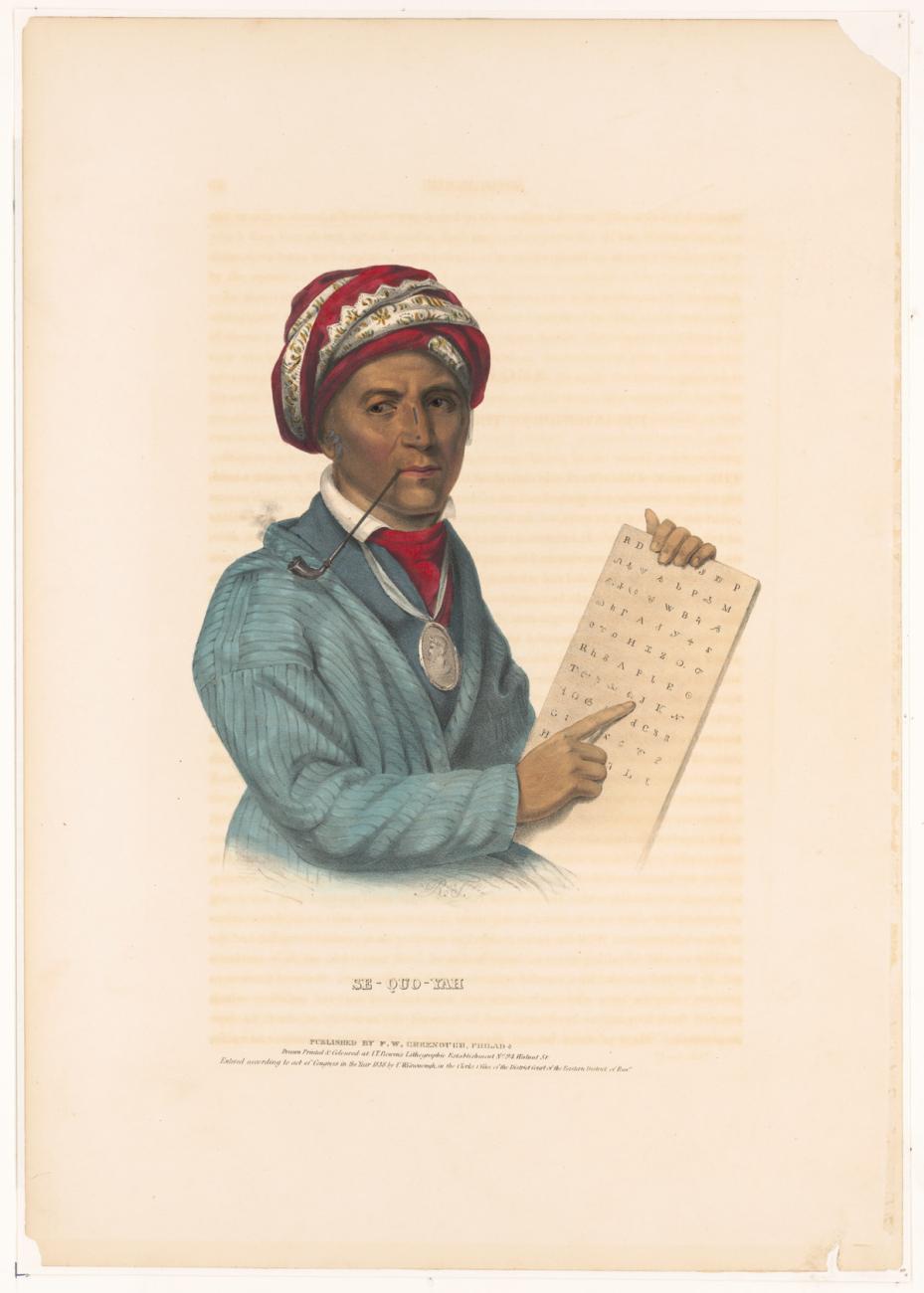
Sequoyah created a written form of his Cherokee peoples’ language, which was used in the Cherokee Nations’ newspaper that was first published in 1828 and is still published today.
Library of Congress, LC-DIG-pga-07569
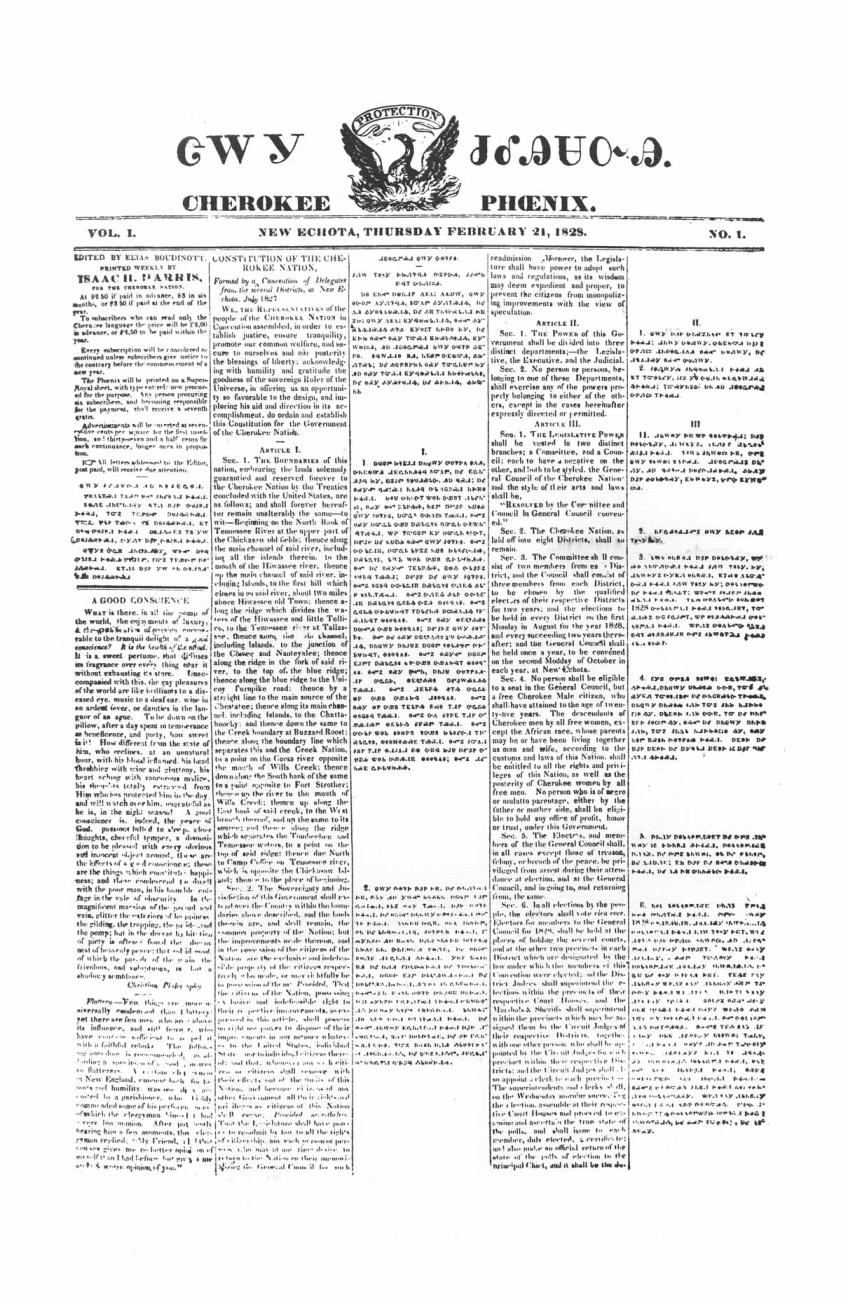
Sequoyah created a written form of his Cherokee peoples’ language, which was used in the Cherokee Nations’ newspaper that was first published in 1828 (above) and is still published today.
Courtesy of Cherokee Nation

This basket in the NMAI collection was intentionally not finished to represent the many treaties between Native nations that have been broken.
“Pieced Treaty: Spider’s Web Treaty Basket,” Shan Goshorn (Eastern Band of Cherokee), 2007; paper and paint; 16.7" x 19.5" x 12.8". 26/6080
Photo by NMAI Staff
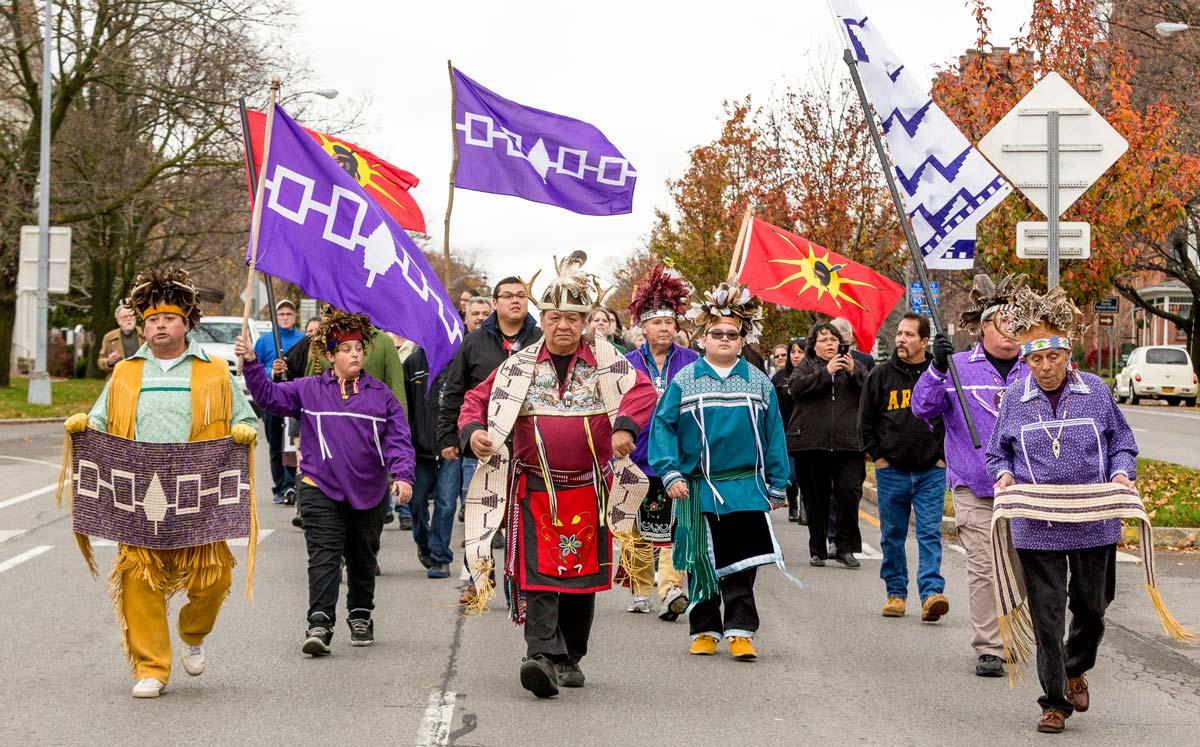
Haudenosaunee Confederacy leaders carry wampum belts at an annual parade to acknowledge the continuation of the Treaty of Canandaigua in 1794.
Photo by Alex Hamer Photography

This shirt in the NMAI collection displays an excerpt from the Treaty of Canandaigua, showing that the treaty is still very much part of Haudenosaunee life.
”Treaty Cloth Shirt,” by Carla Goodleaf Hemlock (Mohawk [Kahnawake]), 2012; muslin, cotton cloth, ribbon, glass beads, quahog clam shell beads, thread and ink. 26/9144
Photo by NMAI Staff
Surviving in a World in Conflict
The European colonization of North America posed threats to its Native nations they had not faced before. Initial contact with colonists during the early 1600s brought waves of diseases that killed hundreds of thousands of people as well as a cascade of social and cultural disruptions.
Indigenous nations found ways to adapt to these new realities. For example, some Native nations found they could gain from trade with the colonists while others developed strategic alliances with European powers.
As more and more European settlers arrived on North America’s Atlantic seaboard throughout the 17th and 18th centuries, settlers demands for increasing amounts of Native territories created tensions that led to a series of military conflicts. At the conclusion of the Seven Years’ War (also known as the French and Indian War) that had lasted from 1756 to 1763, the British forces had defeated the French, who subsequently lost their claims to land in Canada and gave up their claims to territories east of the Mississippi to the British. English colonists along the eastern seaboard saw this as an acquisition of new territories in which to settle. As European settlers pressed for more access to Indigenous lands, tensions inevitably rose.
These strains would lead to Pontiac’s Rebellion in 1763, a war named after Odawa (Ottawa) Chief Obwandiyag (Pontiac) whose Native nation was among those in the Great Lakes fighting against the British. British authorities believed it best to keep European settlers and Native people separated and so issued the Royal Proclamation of 1763. This drew a boundary line along the length of the Appalachian Mountains, saying the territories to the west of that line were to be reserved for Indigenous nations. By the war’s end in 1766, the two sides had reached a stalemate.
Such restrictions clashed with settler ambitions. They had assumed that with the defeat of the French, vast new territories would be open beyond the Appalachian Mountains. This was one of the key grievances that led to the Revolutionary War.
Difficult Choices
At the outbreak of the Revolutionary War in 1775, Native nations faced a stark choice: they could remain neutral in hopes of avoiding being drawn into a war between England and its colonies or ally with one of the two opposing sides that they felt would protect the interests and lands of their people. Native nations east of the Mississippi River were facing distinct challenges depending on their cultures and geographic locations during the war. Those Native people living within one of the 13 colonies were often having to deal with the laws of their respective colonies. Other Native nations were facing a multitude of challenges based on their regional locations. For the six tribes of the Haudenosaunee Confederacy in the Northeast, the Shawnee in the Pennsylvania and Virginia backcountry, and the Cherokee peoples to the South, the colonial frontier played a key role in determining with which side of the conflict they would ally.
The Haudenosaunee Confederacy, known respectively as the Iroquois by the French and the Six Nations by the English, were bound to each other by what they referred to as the Great Law of Peace. This meant that the six nations of the confederacy — the Cayuga, Mohawk, Oneida, Onondaga, Seneca and Tuscarora Tribes — would not fight each other in battle or let outside forces divide them.
Then European explorers and later traders and missionaries began using rivers such as the St. Lawrence and the Hudson to enter the Haudenosaunee homelands in what is now New York and Canada. The Haudenosaunee Confederacy created the “Guswenta,” or “Two-Row Wampum Belt,” that symbolizes a peace agreement made between them and the Dutch during the early 1600s. The parallel rows represent two wakes in water, one of the Dutch traveling in a ship alongside one of the Haudenosaunee paddling in a canoe, equal but separate. During the late 17th century, the British and Haudenosaunee worked out a sometimes-uneasy peace that was known as the Covenant Chain. This metaphoric chain bound the two peoples to a policy of trade, peace and mutual aid. When relations between the nations were strained, diplomatic parties met to “polish the chain” — to strengthen and recommit to its original principles.
However, colonists increasingly pushed into their lands in the Mohawk Valley and tensions between settlers and the Haudenosaunee dramatically increased. During a meeting of representatives of the colonies’ Continental Congress with the Haudenosaunee Grand Council in Albany, New York, in 1775, Native leaders declared the Confederacy intended to remain neutral during the conflicts at that time. To a great extent that neutrality was conditional on the British government and their settlers upholding the limits placed on westward expansion by the Treaty of Ft. Stanwix signed in 1768. Eventually, some Haudenosaunee leaders would see neutrality as untenable and argue for alliances with the British in order to protect their homelands, while others, mostly among the Oneidas and Tuscaroras, were swayed by Presbyterian missionaries such as Samuel Kirkland to take the side of the American patriots.
In the end, after hundreds of years of unity, the Haudenosaunee Confederacy was split and its warriors, now fighting on opposing sides, would meet on the battlefield at Oriskany in 1777. The Mohawk warrior Thayendanegea (also known as Joseph Brant) and the Seneca chief Cornplanter led Haudenosaunee allies of the British loyalists, while the Onieda-German leader Han Yerry led the Oneida and Tuscarora soldiers. Though the British won the Battle of Oriskany, to the Haudenosaunee the site became known as the “Place of Great Sorrow.”
After several subsequent raids on settler communities in the Province of New York, General George Washington would order a “scorched earth” campaign against the Haudenosaunee who were allied with Britain. Led by Generals John Sullivan and James Clinton in 1779, the American troops destroyed some 40 villages and thousands of acres of cultivated fields and orchards, killing many Haudenosaunee people. After this campaign, the Haudenosaunee Confederacy essentially withdrew from the war.
In Pennsylvania and Virginia, the backcountry frontier was very different. Algonquin-language speaking nations in the Chesapeake Bay and Potomac River regions had been overrun by settlers and colonial rule in both of these colonies, which had centers of power such as Philadelphia and Williamsburg that rose in political importance throughout the 18th century. Members of the Lenape Nations (also known as the Delaware) in Pennsylvania, the Powhatan Confederacy in southern Virginia, and the Monacan Indian Nation of the Piedmont Mountains of Virginia and North Carolina were under colonial rule during the 17th and 18th centuries, whereas British territorial claims further westward in these colonies were more undefined.
Among the Native nations in those western regions was another Algonquin-speaking people known as the Shawnee. Colonial accounts mention Shawnee settlements in central Pennsylvania and portions of the Shenandoah Valley in Virginia during the early 18th century. However, by the time of the Revolutionary War, most Shawnee peoples had moved into the Ohio Valley, where they coexisted with Haudenosaunee bands as well as Lenape communities that had been displaced during the late 17th century.
When the American Revolution began, the Shawnee people were also divided between neutrality and alliance with the British, but they eventually sided with the British in hopes of preserving their lands in the Ohio country. Leaders such as Blackfish and Blue Jacket participated in raids against the American positions in Kentucky and were subsequently attacked by American reprisals. The eventual American victory against the British left the Shawnee in a particularly precarious position.
Further south, the Cherokee Nation was also in a difficult situation. Euro-American settlers continued their move westward into Cherokee territory and conflicts arose throughout the 18th century as the southern colonies of North and South Carolina and Georgia came into being. The Cherokee speak a southern Iroquoian language, and like their distant Haudenosaunee relations in the North, their ancestral territories lay between French and British colonial claims in the early 18th century. In 1730, a Cherokee delegation traveled to London and entered into a peace treaty with the British, which guaranteed a period of peace and trade between the two peoples. But in the years that followed, the southern colonies grew and new settlers began to encroach on Cherokee lands.
These tensions would only increase during the French and Indian War. Violence erupted in late 1758 when colonial militiamen attacked a group of Cherokee warriors over alleged horse stealing. This led to the Anglo-Cherokee War, which lasted until 1761. Though technically a war between Britain and its former ally, the conflict was largely waged by settler colonial officials against the Cherokee.
A year after the war ended, Cherokee leaders again traveled to London on a diplomatic mission. The meeting between Cherokee leaders and representatives of the Crown was meant to reestablish their old alliance and to agree to a boundary between Cherokee territories and the colonies. These talks helped establish the Proclamation Line of 1763 that stretched from Georgia to northern Pennsylvania and defined the territory. However, this would only add to tensions between colonial settlers and the British authorities in London.
The peace that followed was short-lived. When the American Revolution began in 1775, the Cherokee Nation upheld its agreements with the British and fought alongside them against American colonists. This would lead to the Cherokee War of 1776 and would continue intermittently until the conclusion of the American Revolution in 1783. After it ended, the Cherokee entered into other alliances with Indigenous nations west of the Appalachians in an effort to preserve the sovereignty of their homelands.
Adapting to Aftermaths
During the American Revolution, Native leadership was often divided between maintaining neutrality if possible or, if not, which side to support in hopes of securing an independent future for their peoples. Ironically, at the end of the Revolutionary War, no Indigenous allies for the British or Americans were included at the peace negotiations that resulted in the 1783 Treaty of Paris that established American independence.
The Revolutionary conflict led to a rupture in the Haudenosaunee Confederacy and to the devastation of their homelands. Meanwhile, the Shawnee, who had already been dislocated and forced to migrate to new territories in the Ohio Valley, would face new threats after American independence had been secured. And the Cherokee would suffer devastating attacks on their homelands and would be forced repeatedly to cede land in hopes of securing a lasting peace. But each of these nations would choose its own path moving forward in the new reality of an independent United States of America.
Having suffered a split in their confederacy and Washington’s scorched earth campaign, it might have seemed that the Haudenosaunee were doomed to lose their cultural identity. But these communities proved resilient. Rather than face continued conflicts with the now United States, the Haudenosaunee agreed to another treaty at Ft. Stanwix in 1784 that included significant land concessions. As the Mohawk Nation in the Mohawk River Valley was closest in proximity to Euro-American settlements, its people were given the choice to migrate either northward to join the Mohawk community at Akwesasne on the northern border of New York with Canada or westward into lands along the Grand River in what is now Ontario, Canada. The other five Haudenosaunee Nations would reside on reservations in their respective homelands.
Some Haudenosaunee people who had settled in the Ohio River Valley were not part of these treaties and therefore were exposed to whatever fate awaited that much-coveted region. In this same territory, other relocated and refugee Native nations such as the Huron, the Shawnee and the Lenape would have to formulate plans for the coming onslaught of settlers eager to take their lands. The Mohawk warrior Thayendanegea (Joseph Brant), who had left to be with his people along the Grand River in Canada, urged the nations of the Ohio region to band together and resist the United States. They quickly recognized that by forming an allied confederacy of nations that they would more likely be able to defend their lands.
This Indigenous alliance was led by charismatic figures such as the Shawnee war chief Blue Jacket and the Miami chief Little Turtle, whose people were at this time in the Great Lakes region. When skirmishes between Native nations and settlers in the Ohio River Valley arose during the 1780s, the United States formed an army charged with defeating this new alliance of Native nations. An invasion from a militia from Kentucky in 1785 initiated the decade-long Northwest Indian War, the United States’ first military conflict since declaring its independence from England.
After initial Native victories came three years of conflicts and great losses on both sides. The U.S. army finally claimed victory at the 1794 Battle of Fallen Timbers. A year later, the Native nations involved were forced to accept the terms of Treaty of Greenville, ceding a huge portion of their lands, most of which makes up the present state of Ohio.
The United States’ early losses in the Ohio region made the new government keenly aware of the continued potential of Indigenous military alliances. George Washington, now president, directed his American Indian agents to make a more lasting peace with the Haudenosaunee. Timothy Pickering acted as Washington’s agent in negotiations with the Grand Council of the Six Nations in the fall of 1794. The result would be the Treaty of Canandaigua, which was signed in November of that year. This treaty, still legally valid today, recognizes the continued sovereignty of the Six Nations within their reserved lands in New York. Even though aspects of it have been violated over the last two centuries, it is still credited with assuring the Haudenosaunee reservations would remain in place even after the passage of the 1830 Indian Removal Act that pushed many Native people off their lands.
The challenges facing the Haudenosaunee tribes during this postwar period were many. Their reduced stature as a political and military power made them vulnerable to New York state extracting more land from them. They would also have to contend with increased missionary presence and other pressures to assimilate to Euro-American cultural norms.
At the beginning of the 19th century, the Seneca prophet known as Handsome Lake began promoting that his people could maintain and revive their ancestral beliefs while at the same time adapting to the present conditions of Haudenosaunee life within the United States. Reservations meant that villages could no longer be moved from time to time to follow resources and that agricultural practices would have to accommodate these more sedentary lifeways. Likewise, domesticated animals would have to make up for the wild game no longer available because of restricted access to their former hunting grounds.
This meant adapting without assimilating, sometimes referred to as acculturation, and at the same time never surrendering their sovereign right to govern themselves. Today, the Haudenosaunee live on eight reservations in New York and six in Canada. The Oneida also have a reservation in Wisconsin and the Seneca-Cayuga have a reservation in Oklahoma.
At the conclusion of the U.S. campaigns against Indigenous peoples in the Ohio region during the 1790s, the Shawnee once again found themselves in a position in which they had to cede most of their territory. Forced out of the Ohio River Valley by the Treaty of Greenville, they now had access to only a small portion of northern Ohio and Indiana territories, which they had to share with other displaced Native nations. This led to bitter divisions within the Shawnee community, with those leaders who had signed the treaty with the Americans seen by some Shawnee people as having betrayed their nation’s best interests.
Following the displacements caused by the treaty cessions, the charismatic Shawnee war chief known as Tecumseh began a mission to unite the various Native nations of the region in an attempt to resist further American settler encroachment. He traveled widely within the Mississippi River Valley and Midwest in an attempt to form a Pan-Indigenous confederacy that could withstand the armed forces of the United States. In describing the benefits of the tribes uniting, records indicate he said, “A single twig breaks, but the bundle of twigs is strong.” His pursuit of intertribal unity was supported in part by his brother, Tenskwatawa, who was known to the English as the Prophet as he preached maintaining Indigenous ancestral religions and practices while rejecting European customs. Together, Tecumseh and Tenskwatawa were able to gather numerous followers from a variety of nations in the region, many of whom had settled together in a community called Prophetstown in what is now northern Indiana.
As Tecumseh worked to build an intertribal alliance, tensions between the United States and Great Britain were growing. The British wished to limit U.S. expansion in North America by supporting Native nations so that they would serve as a buffer zone between the United States and Canada in the western Great Lakes. To this end, the British would sell military supplies to Tecumseh and his followers in the region.
This was a significant cause of the War of 1812 between the United States and the United Kingdom. During late 1811, as Tecumseh was traveling on a diplomatic mission to raise more support for his alliance, the American settlers led by territorial governor William Henry Harrison moved against Prophetstown, a Shawnee village then under the leadership of Tenskwatawa. Harrison had parlayed directly with Tecumseh since the controversial Treaty of Ft. Wayne had led to cessions of even more Native territory in 1809. Had Tecumseh been present at Prophetstown when it was attacked in 1811, he may have been able to forestall open military conflict. Without him, Harrison felt emboldened to move against Tenskwatawa, who was not a military leader. During the ensuing Battle of Tippecanoe, the Shawnee and allied forces were defeated and Prophetstown burned to the ground.
This defeat did not end Tecumseh’s pursuit of an alliance to resist the American advancement into their territories, but it did significantly weaken his position. More and more the Shawnee leader would have to consider closer alliance with the British as tensions between Britain and the United States moved ever nearer to open war. In the summer of 1812, Tecumseh joined with British Major General Sir Issac Brock to capture Ft. Detroit from the Americans and secure the western Great Lakes. This victory revived hopes and led to an unsuccessful attempt to regain lost lands in Indiana and Ohio. When the United States took control of Lake Erie, Tecumseh and his troops retreated to Upper Canada. There, the two sides engaged at the Battle of the Thames in October of 1813. Tecumseh was killed in the battle, and the intertribal alliances he had crafted began to crumble. The dream of an Indigenous republic consisting of many nations that had guided Tecumseh and his followers ended with the eventual peace agreed to between the United States and Great Britain in the Treaty of Ghent, which was signed in December 1814 in Ghent, United Netherlands (modern-day Belgium), and finally approved by the U.S. Senate in February 1815.
The Shawnee Nation would eventually divide into three separate communities, with some people migrating out of the Midwest as early as 1822 while others removed westward after the passage of the Indian Removal Act in 1830. Those first families to emigrate went to the Mexican province of Texas in 1822 but would later be forced out after Texans gained their independence from Mexico. This community resettled in what the U.S. government designated as “Indian Territory,” centered in present-day Oklahoma. (They were later called the Absentee Shawnee as they were not present at the 1854 treaty that established a reservation in Kansas.) Another community of Shawnee and Seneca peoples living in Ohio were removed to Indian Territory in 1832, with the Shawnee families becoming known as the Eastern Shawnee. And finally, another band of Shawnee would resettle in Kansas in the 1830s, only to be removed again to Indian Territory when settlers began moving into the area. They make up the third federally recognized Shawnee community, the Shawnee Tribe.
Many of the Cherokee peoples’ principal towns in the Southeast had been devastated during the Revolutionary War. A smallpox epidemic that soon followed also contributed to their losses. Cherokee society was deeply divided between those who wished to continue reſisting settler encroachment and those who wished to pursue a path of peaceful coexistence. Leaders such as Dragging Canoe would continue military actions against squatters moving into Cherokee territory throughout the 1790s. A peace treaty between the Cherokee people and the United States eventually was signed in 1798 at Tellico in Tennessee.
The main thrust of the United States’ Indian policy during the early years of the republic was to push for the assimilation of Native peoples. The adoption of certain elements of Euro-American culture was seen by some as a means for making Cherokee civilization more understandable to settler governments. At the outset of the 19th century, some Cherokee communities began to allow Moravian missionaries to set up schools in their territories, which promoted literacy and introduced European farming and livestock raising practices.
By the 1820s, the Cherokee leader Sequoyah had developed a Cherokee syllabary, a written form of the spoken language that was based on phonology. Because its written symbols could be rendered as movable type, the Cherokee were able to set up a printing press. In 1828, the nation founded a Cherokee and English language newspaper, the Cherokee Phoenix, which is still being published.
The Cherokee Nation had also established a written constitution, a supreme court and a governing body with two legislative “houses” that met in the nation’s capital city of New Echota, which the Cherokee founded in what is now Georgia in 1825. The Cherokee accommodated these elements of Western culture in many ways to strengthen their assertion of nationhood and sovereignty as the United States was rapidly expanding.
Regardless of these kind of actions by Native nations to adapt to and communicate with their colonial neighbors, however, the United States remained determined to remove them from their lands in the East and force them to move to territories west of the Mississippi. The 1830 Indian Removal Act primarily affected Native nations living in the Southeast and Midwest who controlled large tracts of arable land suitable for agriculture. Native nations living in the Northeast had lost most of their homelands during the early colonial period, and the few that did maintain any land base were confined to reservations.
In the South, the lands of the Cherokee, Chickasaw, Choctaw, Creek and Seminole (who had all adopted aspects of settler culture for self preservation and so the colonists referred to as the Five Civilized Tribes) were especially coveted as they could support large plantations. The Cherokee Nation took its opposition for removal to the U.S. Supreme Court. In the case of the Cherokee Nation vs. Georgia in 1831, Chief Justice John Marshall ruled that Native nations inside the border of the United States were not foreign nations, nor could they be considered independent, but they were nations. His formulation that Indigenous polities were “domestic dependent nations” remains the basis of federal Indian law.
By the law recognizing Indian nations, they retained a level of sovereignty or self-determination different from other communities or states within the new republic. This ruling would not prevent the forced removal of the Cherokee and other Native nations from their homelands, and many died being forced to walk to reservation land in the West on what became known as the Trail of Tears. It did, however, establish the legal grounds of Indigenous sovereignty within U.S. federal law. Some members of the Cherokee Nation had moved West decades before the Indian Removal Act and today their descendants are known as the United Keetoowah Band of Cherokee Indians in Tahlequah, Oklahoma. Others who were forced from their homelands became known as the Cherokee Nation, also in Tahlequah. The third federally recognized Cherokee community, the Eastern Band of Cherokee Indians, remained in their homelands in present-day North Carolina.
The Haudenosaunee, Shawnee and Cherokee peoples each took a different path in response to the American Revolution. In the years immediately after the Americans declared their independence from England, the Haudenosaunee relied on their diplomatic acumen and the revival of their ancestral practices and governance to maintain a throughline to the past while adapting to the present. The Shawnee, who had moved so often to preserve their own cultural identity and independence, built intertribal unity. The Cherokee reinvented and Indigenized Western institutions. Yet each Native nation found means of adapting and enduring throughout the founding of what became a new nation, the United States of America.
Read more about Native nations’ experiences during the Revolutionary War era and download free educational resources from the NMAI’s Native Knowledge 360° website: AmericanIndian.si.edu/nk360/resources/American-Revolution