
On a cold December night in 1773, Francis Rotch, the son of a local shipowner, arrived at Boston’s Old South Church to report on his attempt to resolve a hopeless impasse. Rotch’s ship, the “Dartmouth,” held a cargo of East India Company tea that carried a large import tax. This was one of several taxes England’s King George imposed on American colonists beginning with his “Stamp Act,” passed in part to help pay some of the costs of the Seven Years War between France and Great Britain that ended a decade earlier. A number of battles in that war had been fought on North American soil. The Massachusetts colony Governor Thomas Hutchinson demanded that the tea be landed and the tax paid, but the Boston Sons of Liberty — who were among the patriots pushing for independence from England — had prevented dockworkers from unloading it. Even though the ships’ customs period that allowed it to sit in the harbor was going to expire the next day, Rotch’s final appeal to the governor to land the tea was rejected.
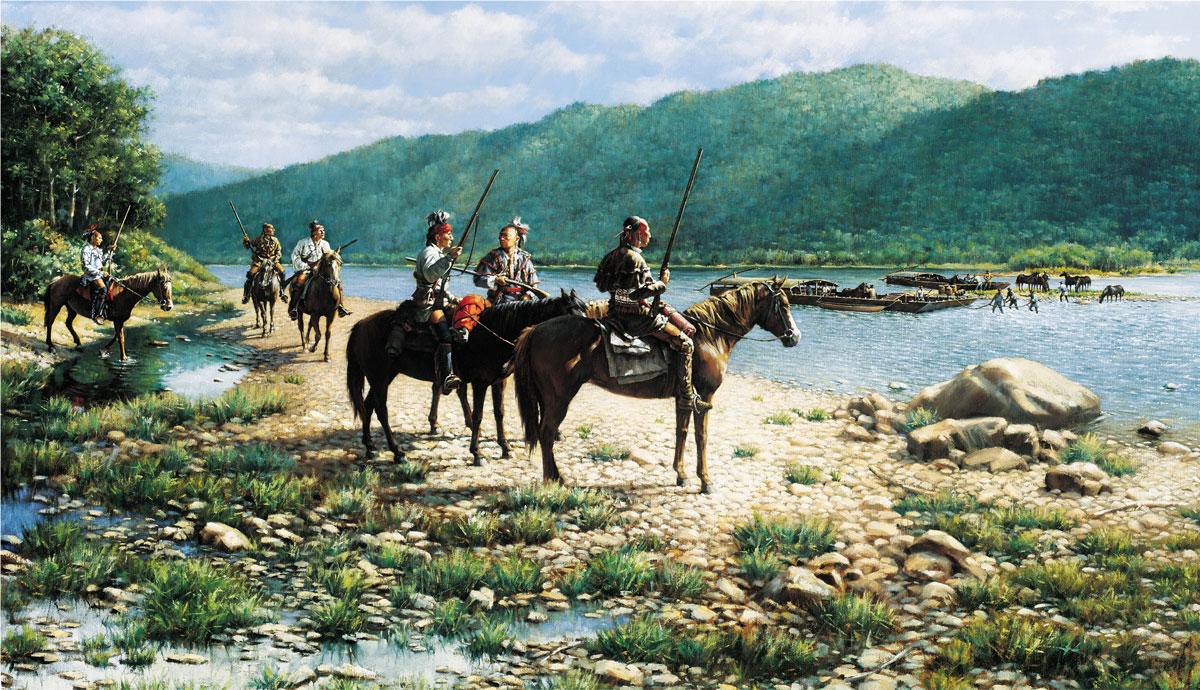
Shawnee riders look over a river in the Ohio Valley as colonists approach.
“How Could Things Get Any Worse,” by artist Robert Griffing and Paramount Press, Inc.

England taxed American goods such as sheets of newspaper (above) and tea (below) in an attempt to pay for some of its cost of the Seven Years’ War.
Stamp, 1765, paper and ink. Gift of John A. Brill, Smithsonian's National Postal Museum. 0.022044
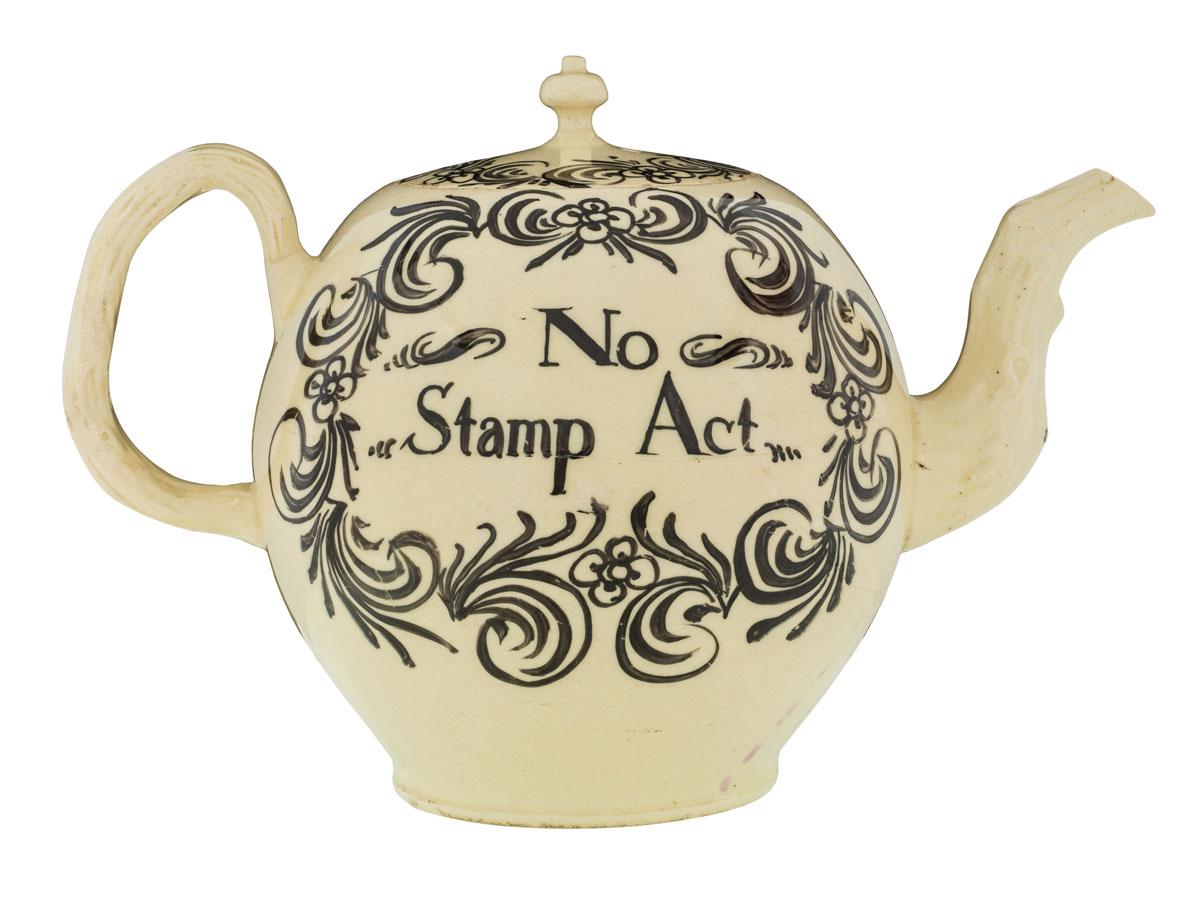
England taxed American goods such as sheets of newspaper (above) and tea (below) in an attempt to pay for some of its cost of the Seven Years’ War.
Stamp, 1765, paper and ink. Smithsonian's National Museum of American History. 0.022044

The British employed the skills of Native scouts, even before the Revolutionary War. Here a Cherokee man observes French troops at Fort Duquesne in Pennsylvania.
“Scouting for the English,” by artist Robert Griffing and Paramount Press, Inc.
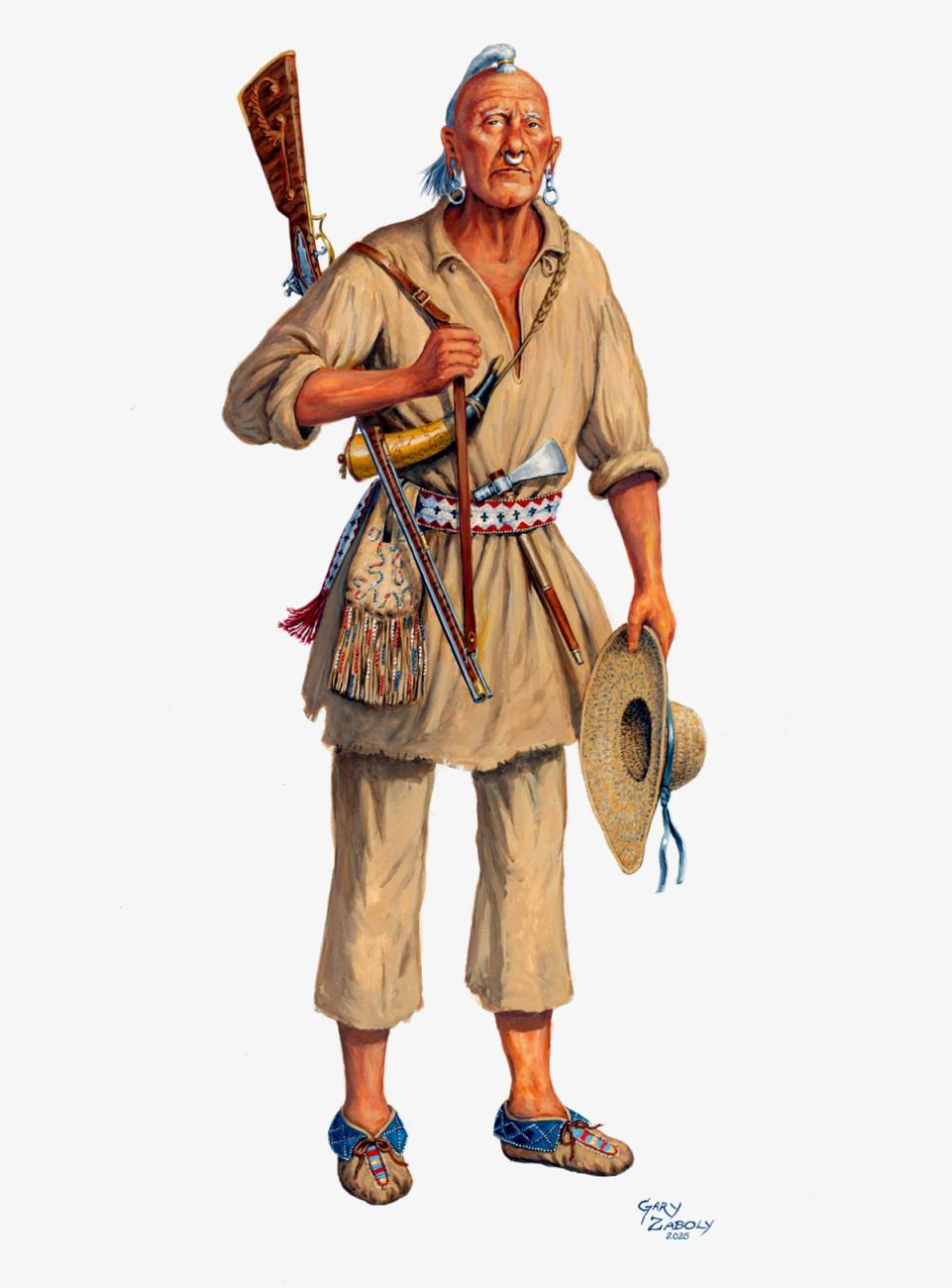
Illustration of a Stockbridge Mohican soldier by Gary Zaboly, commissioned by Kingsbridge Historical Society, 2026; gouache on illustration board, 10"x16".
Courtesy of the Stockbridge-Munsee Community

John Quinney’s (Stockbridge Mohican) armbands; 1793 or 1813. Brotherton, Wisconsin; silver, 2" x 3.3". Formerly in the NMAI collection. Returned to Stockbridge-Munsee community per an ethical returns request.
Photo by NMAI Staff

Left to right: On June 16, 2026, Carolina Wasinger, Nathan Grellinger, Kyle Scherer, President of the Delaware Nation Michael McLane, Chief of the Delaware Tribe of Indians Brad KillsCrow, Lisa Koop Gunn, and a child unveiled the Delaware Treaty of 1778 at the “Nation to Nation” exhibition at the NMAI in Washington, D.C. This was the first treaty between a Native nation and the United States.
Photo by Dontez Henderson, Smithsonian’s National Museum of African American History and Culture

On June 16, 2026, Carolina Wasinger, Nathan Grellinger, Kyle Scherer, President of the Delaware Nation Michael McLane, Chief of the Delaware Tribe of Indians Brad KillsCrow, Lisa Koop Gunn, and a child unveiled the Delaware Treaty of 1778 at the “Nation to Nation” exhibition at the NMAI in Washington, D.C. This was the first treaty between a Native nation and the United States.
National Archives and Records Administration

The Declaration of Independence was adopted on July 4, 1776. It was signed by 56 delegates from all 13 colonies.
National Archives and Records Administration

The flags of many sovereign tribal nations are displayed throughout the National Museum of the American Indian in Washington, D.C.
Photo by NMAI Staff
Hearing the news, the Boston patriots sprang into action. A group of men threw blankets over their shoulders, donned a few feathers and smeared their faces with lampblack in a poor attempt to dress as “Indians” and raced to the wharf. Their chorus of “war whoops” sounded over the water. They overpowered the guards and began dumping tea into the harbor. When the protest was over three hours later, the “Indians” cleaned up the three ships they had boarded and went home to wash off their war paint.
The attack on the tea ships was bold and illegal, so no doubt some participants wished to hide their identities. But Boston was still a relatively small town, and anyone well informed of its politics could have named the likely culprits, from the street captains down to the patriot apprentices stomping barefoot in the harbor, compressing tea into the shallow water. This act of civil disobedience that shocked King George and his loyalist subjects would be among the events that would escalate the American rebellion into revolution.
Although their failed attempt to resemble Native Americans did not disguise much, the patriots still thought this charade was necessary to shift blame of what became known as the Boston Tea Party to “Indians,” who the colonists often viewed as savages. Yet during this eight-year battle for independence that began in 1775 and concluded in 1783 — well beyond the signing of the Declaration of Independence on July 4, 1776 — Native peoples played much more significant roles, including potentially inspiring the idea of being an “American.”
Creating an American Identity
At the time of the Boston Tea Party, England was awash with people starving, unhappy and oppressed. The King and his counselors were always devising new ways to extract wealth from England’s colonial settlements, such as the Stamp Act. Colonists were wanting to create their own identity. When they looked to the wilderness of America, at its beautiful, “wild” lands, these “civilized” English colonists who were being constrained by their own country were often enticed by what they viewed as open spaces ready to be explored and settled in spite of already being inhabited by millions of Native people. They saw Indians as “savage” yet having the freedom they desired. Initially shocked by Native fighting tactics, the American soldiers soon adopted them. When lines of disciplined British troops came marching in their bright red coats, the patriots wearing more muted colors dispersed into the woods and shot the soldiers down from where they hid among the rocks and trees. And they recruited and organized militia fighters from the frontier backcountry who were well-schooled in Indian warfare through their own conflicts with Native peoples. To be a colonial in revolt was to be both British and Indian — and yet to be neither one.
American Indians occupied a primary place in this new revolutionary world, one that was as much geopolitical as it was cultural. From the beginning, Americans tried to bring Native soldiers into the revolutionary fold. A year before the Declaration of Independence was written, Native soldiers had fought and died for the patriot cause at the Battle of Bunker Hill. Wampanoag sailors filled crew rosters among the nascent Continental Navy and the trade and supply ships that kept the revolution afloat. In April 1778, at the end of a desperate winter at Valley Forge, Oneida people brought food to George Washington’s starving troops and others in a multicultural army that included Native soldiers (see “Revolutionary Women” in this issue).
Only days after the declaration was read to a Boston crowd in a town square, at George Washington’s behest, Massachusetts men negotiated the Treaty of Watertown, an alliance with the Mi’kmaq Nation in Nova Scotia and the St. Johns/Maliseet peoples in Canada and Maine. The treaty said these Native nations were to:
furnish and supply 600 strong men out of the said Tribes, or as many as may be, who shall without delay proceed from their several homes up to the Town of Boston within this State, and from thence shall march to join the Army of the United States of America now at New York under the immediate command of his Excellency General Washington, there to take his orders.
Though never ratified, the Treaty of Watertown was the nation’s first international agreement.
The 600-man force did not materialize in New York, however other Native militias were formed. Perhaps the most famous militia included Native troops from Stockbridge, Massachusetts. It was formed as early as 1774 and fought at the Siege of Boston and at Ticonderoga, Saratoga and Monmouth. Stockbridge was a “praying town,” founded four decades before the Revolution by colonial missionaries and Mohican people from western Massachusetts and Connecticut. It was one of the continent’s first multicultural towns, with a range of American Indian people and settlers living together. The Stockbridge militia included Native people from many different tribes, including the Housatonic, Mohican, Munsee, Tunxis and Wappinger. Under longtime Wappinger leader Daniel Nimham, many had fought for the Crown in the Seven Years’ War (also known as the French and Indian War) only to see the Wappinger defrauded out of their land by the British. This caused leaders such as Nimham to form a hopeful alliance with the Americans. In 1774, he pledged:
Wherever your armies go, there we will go; you shall always find us by your side; and if providence calls us to sacrifice our Lives in the field of battle, we will fall where you fall, and lay our bones by yours.
In August 1778, this Stockbridge promise came to sad fruition, when some 40 Stockbridge soldiers were killed by the Queen’s Rangers — a unit descended from Roger’s Rangers, in which so many Stockbridge men had served during the Seven Years’ War.
Building Agreements Between Nations
That same year, the United States sought alliances with the Lenape people of the Ohio Valley (also known as the Delaware). Despite having previously attacked Lenape communities, the Americans needed their permission to march an army across their lands in Ohio to attack a British fort at Detroit. The resulting 1778 Treaty with the Delawares (also known as the Treaty of Fort Pitt) — considered the first formal treaty between a Native nation and the United States — promised peace, alliance, fair trade and jurisdiction. It also included a final article that reflected hope for a just partnership in the future:
And it is further agreed on between the contracting parties should it for the future to be found conducive for the mutual interest of both parties to invite any other tribes who have been friends to the interest of the United States, to join the present confederation, and to form a state whereof the Delaware nation shall be the head, and have a representation in Congress.
The ambiguous legal language of the treaty written in English may have been intentionally hard for the Indigenous leaders to decipher. Yet it alludes to a possibility that the 14th state might have been Native led and therefore that the United States might have become something different.
The reason why the vision of an Indian state did not come to fruition could be found in the language of the Declaration of Independence. While it speaks of liberty, rights and self-evident truths for all men, the majority of the Declaration is a list of 27 complaints lodged against King George. The last of these states:
“He has excited domestic insurrections amongst us, and has endeavoured to bring on the inhabitants of our frontiers, the merciless Indian Savages, whose known rule of warfare, is an undistinguished destruction of all ages, sexes and conditions.”
In spite of Americans adopting Native war tactics and recruiting Native people to fight with them, the Declaration of Independence shows they regarded Indian people as uncivilized and incapable of mercy and so one to whom no mercy need be shown.
The American Revolution was, among other things, a civil war between English colonists. However, the conflict had severe consequences for Native peoples. It initiated divisions between and within Native nations, splitting tribal alliances and communities. Some tribal nations joined with the Americans while others hoped aligning with the British would be the best strategy to protect their lands. Many tribes were divided as to which side to take or tried to remain neutral as long as possible, such as the Cherokee, who had peace leaders cautioning against joining the fight even as younger soldiers under Dragging Canoe began waging war against the colonists taking their land. The American response to the latter was a militia ordered in the summer of 1776 to burn some 50 Cherokee villages. This was among the causes of the dislocation of much of the Cherokee population from the East to Indian Territory.
When the Oneida and Tuscarora sided with the Americans, the longstanding Haudenosaunee Confederacy covered the fire of the six tribes’ meeting longhouse and its leaders halted all council discussions until after the war. This weakened their strong bond and defenses. During the Clinton-Sullivan campaign of 1779, General George Washington ordered his soldiers to destroy Haudenosaunee cornfields, orchards, houses and towns across upstate New York. This also served as a scouting expedition for subsequent American settlement.
The Mohican survivors of the Stockbridge massacre asked the colonists for support, but they were pushed from their homes. They ended up in Wisconsin alongside members of the Oneida Nation.
Many treaties between the newly formed nation and Native nations were broken. For instance, the 1778 Treaty of Fort Pitt lasted 47 days before an American militiaman shot and killed White Eyes, the primary Lenape architect of the agreement. In 1782, American militia would kill 96 Lenape and Mohican men, women and children as well as pacifist Moravian Christians who had tried to stay out of the conflict.
In a series of treaties ratified during the 1780s, rather than pursuing alliances with Native nations, the United States demanded land cessions and political subordination. In the 1783 Treaty of Paris that ended the war, neither the Americans nor the British thought to take Native nations into account.
Reaffirming Tribal Sovereignty
The Native peoples’ struggle for freedom did not end with the declaration of American independence from England. In 1790, only months after the final U.S. state had ratified the Constitution, an alliance of tribes known as the Northwest Confederacy that was contesting westward colonial expansion defeated Lt. Col Josiah Harmar’s force of militia and other U.S. Army soldiers. The following year, the Northwest Confederacy defeated a 1,000-man U.S. Army regiment that was led by Major General Arthur St. Clair. President George Washington pushed for the creation of a standing army that could match the strength of the Indian Confederacy’s military. A large portion of the federal budget went to fund this army for many decades as the United States extended its reach across the continent.
Every American story is also a Native American story, including the American Revolution. The colonists used their perception of “Indians” to symbolize freedom and liberty. Settlers claimed an Indigenous identity from the land itself, even as they repudiated its inhabitants. They blended Native military strategy with European training and organization. They recruited powerful Native allies even as their own rebellious civil war produced devastating divisions among these Native peoples. Self-declared “Americans” proclaimed in their Declaration of Independence that Indians were merciless and savage — and then waged wars and created other strategies to eliminate them and their cultures. This American nation in the making relied upon military treaty alliances with European countries but also frequently sought alliance treaties — and thus recognition of its own nationhood — with Native American nations.
What the American Revolution did do was reveal to those who were unaware that tribal nations are autonomous. Even so, the individuals and tribes who chose Americans as their allies fought and died alongside them so that the United States would be birthed. They — and all Native peoples — are integral to the story of this nation’s founding.