
Standing in the landscape of the National Museum of the American Indian in Washington, D.C., is an unusual family. Made of clay, mud, straw, wood and stone, “Always Becoming” is a group of sculptures that have experienced many changes during the past two decades. Wind, rain and snow have slowly worn down their clay exteriors. Mud daubers have drilled holes into some of their sides to make their homes. Some sculptures formed cracks, while others have shed their bamboo skins altogether, transforming into entirely new beings. While all the details of the sculptures’ evolutions could not be predicted, that they would alter over time was not only expected, but intended.

Nora Naranjo Morse (center) stands with her grandnephews, Benito Steen (front) and Kalin (“Panther”) Steen (back) after they completed the latest phase of the “Always Becoming” sculptures this past spring.
Photo by NMAI Staff

In her studio on the Santa Clara Pueblo in New Mexico, Naranjo Morse works on one of her art pieces made of discarded materials.
Photo courtesy of Eliza Naranjo Morse
This unique vision of public art is that of Nora Naranjo Morse, a sculptor, multimedia artist and poet who has taken her Kha’p’o Owingeh (Santa Clara Pueblo) peoples’ tradition of making creations from clay to new realms. These sculptures of clay evoke Pueblo structures and pottery. “Vessels in our house have a natural life cycle,” she explained. “Once a vessel was no longer needed by the community or family, if it was broken or cracked, it was set outside and allowed to return to the earth.”
The daughter of well-known pottery makers Rose and Michael Naranjo, Nora Naranjo Morse is from an extended family of artists of the Santa Clara Pueblo in New Mexico. As a young woman she tried having a desk job, but as she put it, “My spirit is not meant to be confined in that way.” One day one of her sisters handed her some clay to work with, and she knew as she molded it in her hands that creating art was her true path.
Since the 1980s, she has become known for her whimsical figures that have been an inspiration to others, including NMAI Director Cynthia Chavez Lamar (San Felipe Pueblo/Hopi/Tewa/Navajo). She has known Naranjo Morse since she was a teenager. Chavez Lamar had learned how to create traditional Pueblo figurines, but then she saw some of Naranjo Morse’s imaginative works at an art market. “I was so inspired because she was creating these really abstract figures,” she said. “In a lot of ways, it set me free.”
“Always Becoming” is the embodiment of artistic freedom, not only because of the sculptures’ unique designs and life cycles but because of the many hands that have cared for them since their creation. The winner of the NMAI’s 2006 public art competition, the sculptures were first completed in 2007 by Naranjo Morse; her niece and sustainable architect Athena Steen along with her husband, Bill, and their young sons Benito and Kalin (“Panther”); as well as many NMAI staff members and other volunteers.
For almost every year since, Naranjo Morse and members of her family have returned to tend to the sculptures. This spring, Naranjo Morse was joined by her daughter, Eliza Naranjo Morse, and her grandnephews, Benito and Kalin Steen. The brothers are now part of their family’s Canelo Project based in Arizona, which designs and builds houses and other structures using sustainable Indigenous techniques. Benito said when approaching a new project that he sees “the landscape is the first architect,” and that “the material dictates the structure.”
To revitalize the “Always Becoming” sculptures this past spring, the team knew they would need a lot of materials. Shipping great amounts of heavy clay from the Santa Clara Pueblo was not an option, but they were able to arrange obtaining clay from the yard of Joan and Marx Sterne, members of the Smithsonian Regional Council who have supported the NMAI’s work for years. The team also found the right size and shades of quarry rock from an area shop.
Back at the sculptures’ site, Naranjo Morse’s creativity was contagious. Like the bees in the surrounding gardens, she and Benito flitted from sculpture to sculpture — he overseeing the rebuilding of them and consulting with Naranjo Morse, who put her own touches on the artworks while offering suggestions to the several members of the NMAI staff and fellows who volunteered to help. Together, they rejuvenated the sculptures with new clay exteriors decorated with designs, repaired stone roofs and strengthened the remaining wood poles. “‘Always Becoming’ is the ultimate example of shared stewardship,” said Kelly McHugh, the NMAI’s head of Conservation. “She has allowed all of us to take part in shaping her art.”
In November, “Always Becoming” will be rededicated at the NMAI. The next steps will be to build a pathway to some of the sculptures and install more native plants for pollinators around them. Naranjo Morse and Smithsonian Gardens will work with Diné landscape designer LaShannon Begay, who said she wants to create a space that invites visitors to “slow down and be present, so they can better understand the relationship between people and place.”
Kalin Steen, now a filmmaker, has been documenting the project. As someone who has witnessed the lives of the sculptures since he was a young child, he said he feels “Always Becoming” reflects a basic Tewa principle, to “seek life.” Meaning, he explained, “to have the delicate balance of simultaneously going with the flow of where the river of life takes you while living with intention.”
Like her sculptures, Naranjo Morse is ever evolving. In the past few years, she has been transforming discarded materials into innovative artworks. She started after one day when she had been digging clay out of a riverbank and then turned to see trash strewn about on the opposite hill. “The visual juxtaposition was mind-blowing for me,” she said. “I started thinking about the way humans consume and discard at an unreasonable rate.” She has since turned that trash into art, symbols of Indigenous innovation and resilience.
Naranjo Morse recently exhibited some of these works and collaborated on an exhibition piece with Eliza, whose paintings are inspired by nature. For Eliza, “Always Becoming,” she said, “represents our relationship with ourselves, each other and the land.” But it also “represents possibility,” she said. “Indigenous people have been through so much difficulty, and yet we are always becoming.”
Given that the sculptures are intended to return to the earth, Naranjo Morse said she is pleasantly surprised they have lasted so long. With their recent revitalization and continued maintenance by NMAI staff, her daughter and grandnephews, they might well last decades more. Their continuation is reflective of the resiliency of all Indigenous peoples, Naranjo Morse said, especially this year, the 250th anniversary of the founding of the United States. “In this country, you need to be innovative, and that has made us stronger. Native people have the opportunity to be the forerunners of that.” Yet, she stresses that “Always Becoming” also represents unity: “These sculptures are made for the people, by the people. We need a sense of community moving forward — for whatever challenges we face, we are doing this together.”
Caring for Living Sculptures
“Always Becoming” outside of the National Museum of the American Indian in Washington, D.C., was designed to change over time. Its sculptures are made of earth and plant materials similar to the clay vessels and homes of the Pueblo peoples in New Mexico. These sculptures evoke Indigenous peoples’ deep relationships with their homelands and the materials they provide for building, creating and living. The artwork is continuously transforming and, with the aid of nature, will eventually return to the earth.
“No matter where we live as Native people, we are on this land of our mother always becoming.” — Nora Naranjo Morse
Creating a Clay Family
The NMAI chose “Always Becoming” from 55 entries to an outdoor sculpture design competition in 2006. When the original sculptures were created in 2007, the five figures — Mother, Father and Little One (top) on one side of the museum’s stone patio on the south entrance and Mountain Bird and Moon Woman on the other — looked as they do below.


“Always Becoming,” Nora Naranjo Morse, Kha’p’o Owingeh (Santa Clara Pueblo), first commissioned from the artist in 2007; mud mixture (soil, sand, straw and water), clay, stone, black locust wood and pigments. 26/5840
Gia (Mother), Dta ddah (Father) and Hin-chae-eh (Little One)
Almost every year since their creation, Naranjo Morse and members of her family joined NMAI staff in tending to the sculptures. Yet over time, the bamboo wood exteriors of Father and Mountain Bird and much of the clay daub on the walls of the other sculptures naturally wore away. In spring 2026, the team gathered again at the National Museum of the American Indian to revitalize the clay family.
Scaffolding steadied the workers as they placed carefully selected stones on top of Mother and Little One to provide them new roofs that will help protect the tops of the sculptures from wind, rain and snow. The window through Mother — which aligns with a Grandfather rock on the museum’s grounds — held its shape. The locust wood skeleton of Father still stands several feet tall but was strengthened by fire and oil. The shorter Little One appears to look to the parents nearby, like a playful toddler.
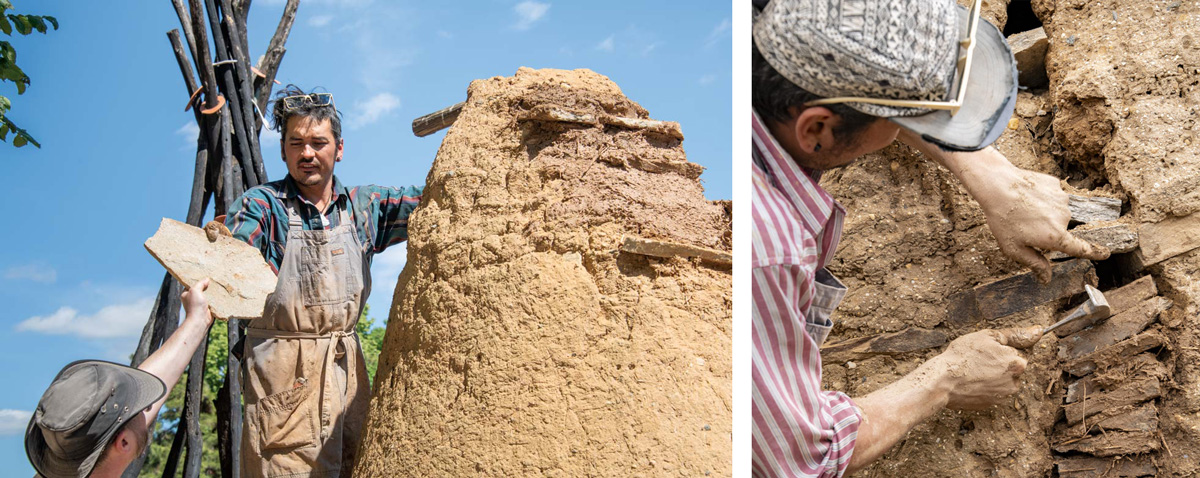
Benito Steen adds stone to Mother to provide her a new roof (above) and flat quarry rocks (left) to fill a crack in her sides.

Left: Charring the remaining wooden poles of Father with fire helps them repel insects and water. Right: John Cross brushes oil onto Father’s poles to help keep them from splitting.

NMAI staff Leo Sylvester and Caitlin Mahony work alongside NMAI fellow Caitlyn Fong to add some cut stones and grooves, enhancing the designs of Little One.

NMAI Director Cynthia Chavez Lamar (right) and Naranjo Morse add stones to complete Little One’s roof.

Left to right: Mother, Father and Little One after their revitalization in 2026.
Pó Kwi (Moon Woman), P’in T’si deh (Mountain Bird) and Tú’eh (Baby)
Opposite to the other three family members are Moon Woman, Mountain Bird and Baby. Moon Woman was inspired by the representation of the lunar cycle engraved on the walk area outside the museum’s south entrance. Despite being pummeled by rain sometimes, she has retained the moons that run down her front like a large string of beads. Naranjo Morse said Moon Woman is the strong, solid auntie, or “Ko’o,” in her Tewa language. “She is the backbone of the family who keeps everyone in line,” she said. The Ko’o are “the women who hold the community together.”
Mountain Bird lost his original bamboo tipi exterior so that only his clay interior remained. But now Baby — a mound of clay and stones topped with a pot — and other family members at his feet are with him, representing the children of Benito Steen and all the generations of caretakers to come.


Kalin Steen films the lunar cycle engraved in the stone walkway outside of the NMAI. Naranjo Morse said this inspired Moon Woman, who “is connecting to something outside of herself — the universe.”

Naranjo Morse presses her fingers into the clay wall of Mountain Bird to create a series of indentations, a pattern often seen on Pueblo pottery.

NMAI’s Conservation Head Kelly McHugh (below, right) and fellow Olga Sofia Calvo roll together pine needles and clay to make coils to build onto Mountain Bird.

Just as if making a Pueblo pot, Benito stacks the coils of clay on top of each other to form an egg-shaped sculpture, symbolic of his children.

Left to right: Baby, Mountain Bird and Moon Woman in their most recent forms.