
When representatives of the 13 American colonies adopted the Declaration of Independence on July 4, 1776, they knew that breaking ties with King George III of England was punishable by death. Still, they chose independence and were willing to fight for it — some alongside Indigenous peoples who already had their own sovereign nations. Yet 250 years later, American Indian nations struggle to protect their sovereignty.
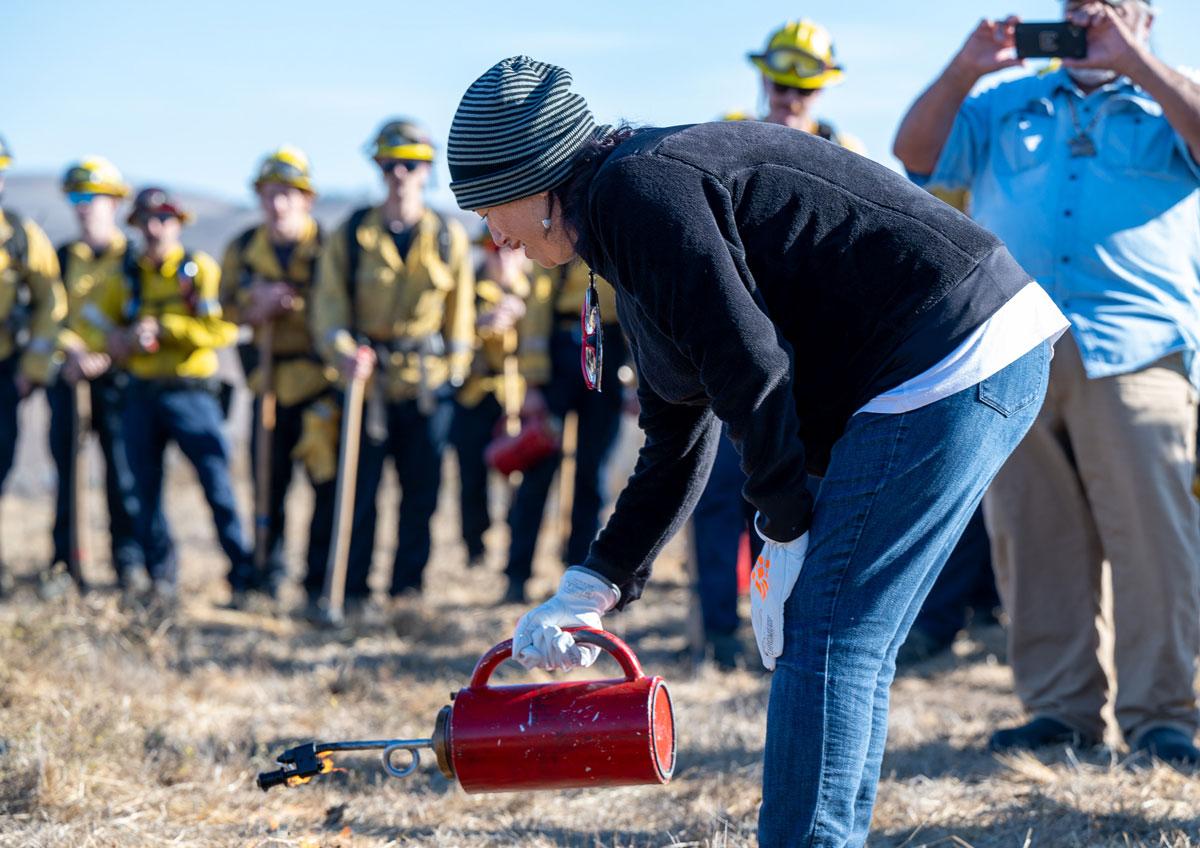
Yana Ross, a citizen of the Federated Indians of Graton Rancheria, lights a prescribed fire at Tolay Lake Regional Park in Northern California to reduce overgrowth and the risk of severe wildfires.
Photo by Alex DeGeorgey, Courtesy of Federated Indians of Graton Rancheria

Greg Sarris has served as the chairman of the Federated Indians of Graton Rancheria since 1992.
Photo by Beowulf Sheehan
Tribal sovereignty is not something the U.S. government invented or bestowed upon tribes. It is an inherent right that existed long before European contact. For instance, hundreds of years ago, the Haudenosaunee Confederacy of six tribes in what is now New York and Canada created their own “Great Law of Peace,” which established principles of tribal interaction, justice and civil authority, by which all still live.
Soon after the arrival of Europeans to North America, American Indians began feeling the impacts on their lives. For example, Plains Indians adopted a horse-based culture after herds of Spanish horses wandered onto the Great Plains from Mexico, which expanded their hunting range. Trade routes also lengthened, increasing the opportunity to trade not only with other nations but with settlers. Yet other interactions had dire consequences. During the American Revolution, many tribes, including those of the Haudenosaunee Confederacy, were divided as to whether the British or the Americans could better help them retain their lands and found themselves fighting on opposite sides.
The year 1776 was of particular significance to my tribe, The Federated Indians of Graton Rancheria, who are descendants of Coast Miwok and Southern Pomo Nations from Marin and Sonoma Counties just north of San Francisco. Although Sir Francis Drake landed on our shores in 1579 for 36 days to repair his ship, our culture began to truly be altered with the establishment of Mission Dolores on Ohlone Nations’ land in what is now San Francisco on October 9, 1776. Spanish soldiers crossed the San Francisco Bay in search of more Native recruits to work in the mission. Although some initially may have accepted the invitation willingly, they must have soon understood what Spanish contact meant: forced labor, conversion to Catholicism, disease and other detrimental impacts. When the missions were secularized in 1834, Indigenous peoples found ourselves once again forced into labor, now for Mexican generals on their large ranchos. When California became a state in 1850, one of the first laws enacted was The Act for the Government and Protection of Indians. While it supposedly let American Indians live on their lands, among other affronts, it legalized indentured servitude, convict leasing and the abduction of “vagrants” to be sold as slaves to the “highest bidder.”
Federal law stipulates that a treaty with a Native American tribe is a formally negotiated, legally binding contract between the United States government and a sovereign tribal nation. Under Article VI of the U.S. Constitution, which was penned in 1787, these treaties are recognized as the “supreme Law of the Land,” placing them on the same legal tier as federal statutes and treaties with foreign countries. This stated that tribes have a government-to-government relationship with the United States, enabling them to interact directly with the U.S. government— not as racial groups but as sovereign nations dealing with another sovereign nation. While members of Native tribes within the United States must abide by federal laws and are citizens of both nations, Native nations have their own governments and laws, manage their lands, and have their own schools and municipal services.
Most treaties made between the U.S. government and Indian nations occurred in the wake of the Declaration of Independence, between 1778 and 1871. These treaties were predicated on compromise. We negotiated with the federal government in the context of military defeat at a time when settlers already occupied the majority of Native lands. Large Indian nations such as the Creek and Cherokee had been marched from the southeast more than 1,000 miles to Oklahoma. Plains tribes were forced onto plots of lands (later called reservations) they were forbidden to leave and were prohibited to hunt or fish outside these designated boundaries.
The U.S. Congress enacted the California Indian Rancheria Act in 1910 supposedly to aid the “homeless Indians of California” displaced by Spanish and Mexican colonists between 1776 and 1846. It stipulated that the federal government provide the survivors “reservation land” and that Indians assigned these lands would have the same sovereign rights as other U.S. Indian tribes. In 1958, Congress passed the California Rancheria Termination Act (Public Law 85-671) as part of a broader 1950s policy intended to force Native peoples’ assimilation into colonial life and end federal oversight of tribes. California tribes lost status as independent sovereign nations, and individuals were no longer considered Indians for government purposes.
Many tribes were terminated without their consent. The Graton Rancheria, established in 1920 for displaced Coast Miwok and Southern Pomo Indians, was terminated illegally in 1966 only to be restored by an Act of Congress on December 27, 2000. As an independent Native nation, the Graton Rancheria has been able to accomplish much for its people, from establishing education opportunities to restoring wetlands and forests on its lands.
Yet some American Indian tribes that were never federally recognized as sovereign nations continue to fight for that status today. Even those federally recognized continue to negotiate with states, cities and local municipalities to protect hunting rights on ancestral lands as well as sacred sites outside of reservations.
Every tribal nation should have the freedom to self-govern, to make its own decisions for its people and manage its own lands. Tribal sovereignty also enables the U.S. government and American Indian tribes to work together. Traditional Indian knowledge is needed now more than ever. Imagine what the Spanish padres and soldiers at Mission Dolores might have learned from Indigenous people about the importance of controlled burning, which reduces dense brush and therefore the intensity and spread of forest fires. Today, working with conservationists, we teach the practice of controlled burning to land managers. Tribes in Northern California and Oregon also worked with the federal government to remove the Klamath River dams, restoring not just the annual salmon runs crucial to their culture but to an entire river ecosystem that benefits all the people and wildlife in the region that depend upon it. When tribal sovereignty is respected and upheld, it can be for the benefit of all.